With AI tools increasingly used in finance, a common concern among professionals is whether or not automation will replace their expertise. In this article, we look closely at AI’s current role in finance, its long-term impact on industry jobs, its benefits and limitations, and how and why human-AI collaboration is the predominant future model.
Key Takeaways:
Finance teams will not be fully replaced by AI. Automation is taking over repetitive, high-volume tasks, meaning roles will evolve, not disappear.
Finance professionals will still need to make judgments, take accountability, build strategies, control AI outputs, and communicate with their boards.
AI is exceptional at data handling and reconciliation, but cannot make reasoned judgments, apply ethics or in-depth context, or make reliable high-level decisions.
By leveraging AI, finance teams can cut cycle times, gain more visibility into data and workflows, and develop more accurate reports and forecasts.
What Is the Role of AI in Finance?
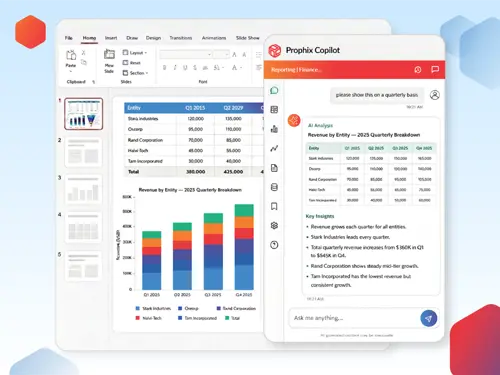
Artificial intelligence in finance is a force multiplier, used to automate, analyze, and surface insight from high-volume financial data. It augments human expertise - AI handles volume and speed, while human judgment oversees complex tasks that require contextual understanding, with finance teams taking ultimate accountability.
Adoption has grown rapidly across finance functions of different sizes and needs, with research suggesting that at least 75% of organizations are using AI to help plan, report, and analyze finance. Most importantly, AI works alongside finance teams - despite job security fears, the big picture is more nuanced (and still requires a human touch).
Let’s explore some tangible impacts of AI on finance jobs in practice, its limitations and benefits, and why human-AI collaboration in finance is a reliable strategy for success.
The Real Impact of AI on Finance Jobs
Will finance be replaced by AI? Broadly, no - AI in finance isn’t taking over entire roles, but is targeting very specific task categories. For example, highly repetitive, high-volume functions such as data entry and reconciliations are most open to AI solutions in finance settings. These tasks are delegated to machine learning, while human experts analyze and strategize the data it prepares.
AI’s potential disruption to a finance team is highly concentrated, not across the board. Finance and accounting personnel adjust their workloads and roles gradually as AI is phased across workflows—meaning their capabilities evolve.
Senior and other roles requiring judgment and accountability are largely unaffected. In fact, companies adopting AI for finance can move experts toward analysis and strategy design, away from data collection and cleaning, retaining talent instead of cutting personnel.
This has a positive net benefit for finance teams, with work becoming more varied, stimulating and better aligned with their skillsets. Research suggests that finance leaders view preparation and reconciliation as their biggest data handling challenge.
Ultimately, autonomous finance isn’t changing job titles — it’s the work within the roles that is shifting, and for the better.
What AI Can and Cannot Do in Finance
AI in finance is quickly maturing and carries broad efficiency and productivity benefits, however, there are some limitations to consider. The crucial difference is that AI cannot reliably understand wider business contexts and ethics, or be relied upon to make snap judgments in unprecedented situations.
Handle and process high transaction volumes at speed
Replicate judgment and contextual interpretation needed for regulatory and tax affairs
Flag anomalies and exceptions for human attention in real time
Be relied on to act without human review and intervention
Analyze large and complex datasets to support stronger forecasting
Assume professional accountability for decisions made and actions taken
Process data in real time to support faster, more predictable close cycles
Make ethical judgments and apply professional skepticism and nuances
Reliably handle high-volume tasks to free human personnel to focus on strategy and analysis
Innovate in reaction to unprecedented activities or events
Key Benefits of AI Integration in Finance Teams
When integrated effectively, finance teams can use AI to reduce variance, detect fraud, cut cycle times, and gain crucial visibility into critical accounting areas.
Improve forecasting accuracy with more reliable, real-time access to data, thus supporting variance reduction from actuals
Reduce month-end close cycle times by aggregating data on a rolling basis (like Jamul Casino, which improved month-end close processes by 30% with Prophix One)
Catch hidden anomalies that rules-based systems frequently overlook, with machine learning fraud detection
Gain faster visibility into cash flow with detailed, personalized, real-time finance and accounting dashboards
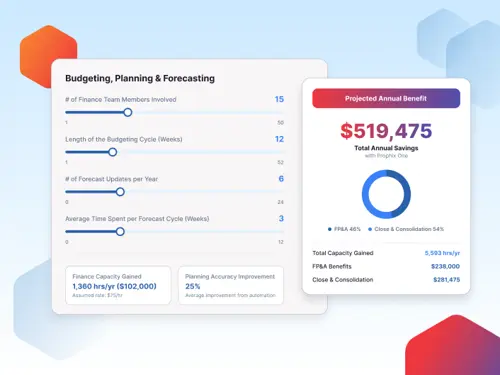
Save considerable costs on preparing, cleaning, and aggregating data, rectifying errors, and planning expenses (like Sammons Financial Group, which saved $100,000 on yearly operating expenses transitioning to automation and AI)
AI Adoption Strategies in Finance That Are Actually Working
Adopting AI effectively is a careful, measured process that demands high-quality process and workflow design, gradual team upskilling, and clear governance. Teams that follow these steps are more likely to benefit from a smoother transition from manual operations to automation success.
Let’s break down five practical strategies to help you augment your processes with AI.
Start With a Process Audit
Carefully lay out your workflows and identify bottlenecks (e.g., where month-end close cycles slow down) that AI can help to reduce.
Alongside, ensure the data you prepare for AI is clean, structured, and centralized, identifying information and integration gaps before deploying. This helps to prevent AI from accelerating these problems further.
Build a clear audit trail to ensure regulators can see where AI will interact with datasets and to what extent. A glass-box AI solution, which records and explains decision logic and remains auditable, will help keep processes transparent and trackable after deployment.
Prioritize Change Management Before Technology
Transitioning from predominantly manual processes to AI poses a potential culture shock and operational disruption if not phased in gradually.
A successful AI rollout needs careful, phased change management. Doing so helps to maintain operational and system continuity, while allowing teams to adapt and upskill.
Prioritizing change management ensures you lock in ROI over time - even with the best AI solution, finance teams must buy in and understand how it works for the investment to pay off.
Phase the Rollout by Function
Rolling AI out as a generalized solution across all workflows risks operational disruption, confusion, and frustration. Instead, deploy solutions one function at a time, prioritizing those which carry the most manual demands.
For example, initially deploying AI to manage invoice matching gives finance teams time and space to adjust to the new technology, and allows reviewers to focus on its performance in this one specific area.
Upskill the Team Alongside the Tools
Gradually upskilling and building capabilities means finance teams can steadily acclimatize to AI, potentially reducing resistance and helping professionals see tangible benefits. What’s more, gradual upskilling helps AI output handling knowledge to settle and build, transforming finance skillsets from data gathering to strategic analysis.
It is also a good opportunity to receive and consider feedback from users, shaping further rollout steps — and to ensure finance knows explicitly how to handle and calibrate AI so it remains compliant.
Set Up Governance Before Going Live
Going live with AI without clear governance and review checkpoints risks inaccurate reports and decision-making that hasn’t accounted for ethics and contexts.
Keeping a human in the loop ensures finance is always in control of outputs and that they keep accountability in line with compliance demands.
Setting up governance before going live supports fully-compliant, accurate, and confident reporting for better-informed decision making.
Why Human-AI Collaboration in Finance Outperforms Either Alone
Human-AI collaboration in finance is both the present standard and the optimal working setup for the years ahead. For finance professionals, there are immense time and effort savings in augmenting processes with automation, and by keeping humans in the loop, AI is constantly and continually reviewed.
AI tools pore through large-scale, complex datasets and compile raw insights at a fraction of the speed at which human expertise is capable. They pull and query raw data, freeing finance teams to spend extra time analyzing and strategizing with this information.
Finance professionals now direct and review outputs - they are no longer hunting for, cleaning, and collating data manually and at scale. That means their roles and skillsets are evolving as AI adopts volume tasks, not disappearing.
For example, communication and judgment skills are becoming more valuable to finance recruiters. Their boards want professionals who can build reliable reports and create clear narratives with the data that tools prepare.
In addition, boards also want finance professionals to understand risk factors when working with AI, especially as it is gradually phased across workflows. It’s here where teams can gradually build capabilities and upskill as AI adjusts their roles over time.
Regulations, too, will always require human accountability regarding decisions made and reports posted.
Finance teams that balance tool-generated insight with expert human interpretation produce better outcomes.
Future Outlook for Finance Professionals in an AI-Driven Industry
AI in finance is here to stay, and with it, the next decade is likely to bring a raft of data governance, CFO responsibility, employer expectation, and compliance framework changes.
Well-positioned finance roles will continue to evolve as AI increasingly takes up volume tasks. This means some responsibilities will be reduced; however, there will be a greater need for AI auditing, governance, and review — especially as reliance on its insight gathering increases.
Well-positioned CFOs, in particular, can expect shifts in responsibilities toward broader technology and strategy considerations. This is likely to include closer involvement in ensuring data security and AI guardrails, working with IT to build and refine tech stacks, and upskilling and redefining the roles they oversee.
Employers that carefully integrate AI with finance will also expect staff to be able to read and validate specific AI tool outputs as standard for FP&A. These expectations not only apply to current staff via upskilling, but also to prospective hires — meaning experience with AI output interpretation is likely to be advantageous when applying for finance roles.
Compliance frameworks are already evolving with AI in mind. The AICPA and ICAEW, for example, have added digital literacy skills and ethics to their competency expectations. The latter, in fact, supports a GenAI accelerator to help upskill professionals.
Over the next decade, the strongest career position in finance will be the specialist who can easily transform AI tool insight into reliable, actionable forecasting and reporting at speed.
Conclusion
AI is already changing the way data is processed and handled for closes, forecasts, and reports. An AI-augmented finance team is one that upskills alongside technology, becoming more confident and adept with analyzing outputs, and emerging as key strategic partners in their business. Take the next step in embracing AI for finance by watching the free Prophix One demo and reach out to our team to learn more.
FAQs
Q1. Will AI fully replace finance teams?
No, AI will not fully replace finance roles. It is exceptional at handling high-volume tasks and repetitive reconciliations, but cannot apply contextual judgments, make reliable ethical decisions, or take innovative actions during unforeseen circumstances. Finance personnel will always have these important roles in supporting reliable decision-making.
Q2. Which finance jobs are most at risk from automation?
Few finance jobs are under threat from automation; rather, AI is taking on specific tasks within these roles. For example, tasks such as data entry, exception routing, and routine reconciliations are already being automated by finance teams. Research suggests AI will also help to create 170 million new jobs by 2030.
Q3. What skills should finance professionals focus on building?
As AI in finance continues to mature, finance professionals should focus on building skills in critical AI decision evaluation, scenario planning, AI governance and guardrail handling, and data storytelling.
Q4. Is AI adoption in finance already happening, or is it still early?
AI adoption in finance is already widespread, with usage among leaders roughly doubling since 2023. The most efficient and valuable finance teams are already using AI to manage high-volume, manual processes, meaning its place in finance productivity is cemented.
Q5. How should a finance team prepare for this change?
Finance teams should focus on mapping out their current foundations and process design by standardizing workflows and centralizing data, and gradually testing and rolling out AI one function at a time. Similarly, finance teams should approach upskilling gradually alongside rolling out the technology.