- Generative AI is used across finance and accounting functions such as forecasting, reporting, maintaining compliance, and automating data entry processes.
- Used effectively, GenAI helps to reduce manual data preparation time, compress close cycles, and ensure rolling compliance with continuous documentation.
- Finance teams remain accountable for output accuracy and keeping compliant. Human oversight is essential, and expert judgment will always be required.
Generative AI is already transforming the way finance and accounting teams manage core functions and high-volume tasks. However, using AI effectively and reaping its productivity and efficiency benefits relies on a clear understanding of where it applies best and gradually rolling it out across workflows.
In this article, we explore common generative AI finance use cases that the most successful teams are already putting into practice, and how you can adopt them for your own functions.
What Generative AI Is and Why are Finance Teams Adopting It?
Generative AI, or GenAI, refers to artificial intelligence models that create content and generate outputs based on patterns from large, complex datasets. The key difference between current GenAI and legacy automation is that it can interpret context and generate responses dynamically, rather than following preset rules.
With responsible implementation, GenAI augments existing finance workflows - it doesn’t replace roles or expertise outright. For example, it can augment manual data reconciliation and close preparations by suggesting data matches and drafting summary documentation, flagging exceptions for review.
However, there is still a vital need for a human in the loop. Human oversight helps to ensure that decisions made by GenAI are relevant, ethical, and accurate. Therefore, the most efficient finance teams carefully control AI functions with review checkpoints built into workflows and processes, ensuring appropriate review of high-volume work before acting on outputs.
AI used in financial planning & analysis can also raise exceptions and data anomalies for human review while processing and summarizing datasets, preventing it from building outputs on poor-quality and incomplete information.
Key Benefits of Generative AI for Finance and Accounting Teams
The key benefits of using generative AI for financial analysis and accounting revolve around time and productivity gains, improved process consistency, and stronger audit readiness support.
- Delegating high-volume, manual tasks to GenAI reduces the time and effort teams spend on data processing and grants more freedom for data analysis and strategy building.
- AI-assisted matching helps compress close cycles, with insights available on demand and less last-minute manual rework.
- Consistently reconciling and matching data - and building summaries and reports - with AI builds a digital auditing trail that is more compliance-ready and easier to explain to auditors (particularly with glass-box AI, which records logic and supports traceability).
- Moving teams away from high-volume tasks means finance and accounting teams can scale capacity and grow more efficiently without increasing headcount.
Use Cases for Generative AI in Finance and Accounting
GenAI is used alongside broader AI and automation across finance functions and workflows, in particular supporting summarization, regulatory reporting, forecasting support, and workflow acceleration.
Automation of Financial Processes
Core accounting tasks, such as reconciliations, journal verifications, and close processes, traditionally require extensive manual time and effort.
Generative AI, however, can help to automate these high-volume tasks by analyzing large, complex datasets and identifying and matching specific information that would otherwise consume hours of human work. GenAI, specifically, can then summarize findings and present insights in natural, actionable language.
Finance stays in control - AI can quickly identify anomalies for human personnel to remedy ahead of cycle deadlines.
Document Generation and Data Synthesis
Manually building accurate reports and generating actionable documentation from complex datasets is time-consuming and can lead to errors.
GenAI supports a faster, more consistent document generation and data synthesis process by writing custom reports and commentary based on specific finance guidelines. Used effectively, it can pull data from fragmented sets and build board and audit-ready narratives and explanations, with broader glass-box models fully explaining logic used.
Integrating GenAI in this way, while using governance checkpoints, helps finance and accounting teams build draft reports and performance summaries more efficiently, ensuring decision makers have access to insights when required.
Financial Forecasting and Market Analysis
Relying heavily on manual, spreadsheet-based modeling risks scenarios and forecasts becoming obsolete by the time they are ready.
What’s more, manually developing “what-if” scenarios relies on human time and effort, meaning scope and insight are potentially limited, leading to CFOs increasing headcount.
Integrated AI, however, can dynamically aggregate live and historical data in real-time, providing teams with a clear understanding of their current position. AI in financial forecasting also builds realistic insights on demand in natural language for decision makers to take action from.
GenAI fits in by crafting narrative explanations and helping decision makers explore multiple “what-if” cases more efficiently. This gives decision-makers access to more potential outcomes, faster, based on more accurate real-time positions.
Fraud Detection and Risk Management
When relying on traditional, manual processes, sophisticated fraud patterns get overlooked - and risk modeling requires extensive investigation and analysis, consuming time better used for taking action.
Broad finance AI tools sweep datasets to spot anomalies and suspicious activities at speed and scale, based on finance presets and guardrails. This allows for faster, more accurate exception spotting and analysis, giving teams more time to remediate.
These capabilities also enable finance teams to build stronger defenses against potential risks, faster - ensuring they are more robust against threats. With explainable AI, finance teams have control over flags raised and can retrain models with feedback.
Regulatory Compliance and Reporting
Maintaining regulatory compliance and audit readiness requires continuous oversight - and following mostly manual processes presents a number of risks and efficiency challenges.
AI can continuously record, match, and summarize data, building a transparent auditing trail. Humans have control over exceptions when raised for review, and AI continuously scans datasets and processes. GenAI, in particular, organizes the data pulled and centralized into summaries and insights aimed at auditors or board members who need real-time analysis.
Internal Stakeholder Reporting and Self-Service
Finance teams field a constant stream of the same questions from budget owners and department heads: where a number came from, why a line moved, what's left to spend. Answering each one manually pulls time away from analysis.
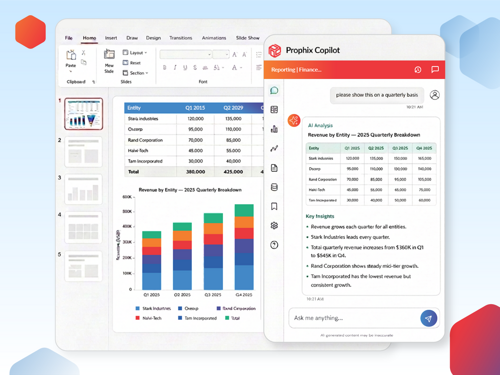
Generative AI lets finance stand up self-service reporting, where stakeholders get context-aware responses to natural-language questions about plans, actuals, and forecasts—without finance acting as a manual lookup service. Customer data analysis becomes internal data analysis: GenAI drafts the variance narrative and tailored insights, and finance reviews them for accuracy and context before they go out.
Client history summarization applies just as well to internal reporting. Board packs, departmental budget recaps, and monthly performance briefs that once took hours to assemble can be drafted automatically from live data through automated communication workflows, with finance reviewing tone and accuracy before sharing. Glass-box explainability matters here: every figure a stakeholder sees needs to trace back to its source, so finance can stand behind it in any review.
Research and Scenario Analysis for Planning
Building a forecast or a planning assumption often means parsing large volumes of source material—prior budgets, contracts, earnings transcripts, internal reports—before any modeling can start. Done manually, that research layer eats into the time available for actual analysis.
Generative AI accelerates that groundwork by summarizing long documents, pulling relevant figures from fragmented sources, and surfacing the context behind an assumption in natural language. Finance teams can interrogate their own historical data the way they'd search a document, getting to a defensible starting point for financial modeling faster.
The same capability strengthens scenario work. GenAI supports scenario modeling and stress testing by drafting the narrative around multiple "what-if" cases—summarizing the drivers, risks, and implications of each—so finance can explore more outcomes in less time. Paired with predictive analytics on live and historical data, this gives teams a clearer read on their current position and where it's heading. Finance retains ownership of every assumption and decision, with AI augmenting the research and modeling underneath, not replacing the judgment on top.
Building Internal Capability and Standardized Workflows
Adopting generative AI doesn't require a data science team. No-code and low-code tools have lowered the barrier so that finance teams can build AI-assisted workflows themselves—standardizing how reconciliations, reporting, and close tasks run without waiting on IT or outside developers.
That accessibility lets finance handle custom workflow integration around how the work actually gets done, then refine it as confidence grows. Standardizing high-volume workflows this way reduces the variation and manual rework that fragmentation creates, so accuracy and speed gains hold up across cycles rather than living in one person's spreadsheet.
Long-term success depends on continuous training and skill development alongside the technology. As GenAI tools evolve, finance professionals build the AI literacy to work with AI outputs, validate decisions, and fold new capabilities into existing workflows. Teams that build that fluency early are best positioned to scale AI responsibly across their finance function.
Integrating Generative AI With Existing Finance and Accounting Systems
For an effective generative AI rollout across existing finance and accounting systems, data sources should be clean and centralized - and, all data platforms and sources should integrate smoothly. AI needs to work with a fully-integrated, centralized data system, otherwise it risks producing unreliable outputs.
Good integration and clean process design matter more than the AI tool you choose - because training on a poor-quality setup risks AI accelerating its problems, not resolving them. Effective integration across all systems also ensures that glass-box AI can provide rationale behind its decisions, which finance and auditing can trace back with minimal effort.
For optimal accuracy, finance teams should prioritize AI platforms that are designed with their functions and existing systems in mind. And, tool quality doesn’t always mean outputs will be reliable by default.
Implementation Challenges and Solutions for Finance Teams
Successful, scalable generative AI implementations in finance account for data quality and privacy, human-in-the-loop controls, pre-launch governance and explainability, change management, and team adaptability.
Let’s explore some common implementation challenges, and how successful finance teams are overcoming them.
- Before implementing GenAI, finance teams must critically ensure data integrity and privacy - or, there is a risk of unreliable outputs and breaching compliance. Before rolling AI out across workflows, process design must account for clean, centralized data and ensure protections in line with compliance requirements.
- Every AI-assisted workflow requires structured human review at defined checkpoints. Without them, misconfigured rules or unexpected outputs can flow through undetected — creating reconciliation errors, audit gaps, or compliance exposure that is significantly harder to resolve after the close than before it.
- A common barrier to deployment is legacy system complexity and integration. Before rolling GenAI out across an infrastructure, finance teams must carefully test existing systems and connections, replacing legacy systems (if necessary) with those that scale with AI.
- Going live without clear governance, auditability, and explainability models risks non-compliance. To safely adapt to AI, processes must be adjusted to ensure that all decisions made are fully explainable and that human personnel remain fully accountable.
- Long-term success with GenAI in finance depends on building team capability alongside the technology. A phased rollout — starting with high-volume, well-defined workflows and expanding as confidence grows — gives finance professionals time to develop familiarity with AI outputs, understand where their judgment is needed, and build the governance literacy that responsible AI use requires. When teams are involved in the design process from the start, adoption follows naturally.
Conclusion
Generative AI is already reshaping finance and accounting functions - reducing manual work, compressing cycle times, and freeing personnel to work on more analytical and strategic projects.
The use cases we’ve explored in this article offer a simple overview of how AI could make your own finance and accounting functions more efficient, transparent, and reliable. Consider which cases are most relevant to your team - and to learn more about the wider benefits, book a free demo of Prophix One today.
FAQs
Q1. What is generative AI in finance?
Generative AI in finance is technology that helps teams to draft reports, summarize complex financial information, explain forecasting analysis, and boost documentation and reporting efficiency.
Q2. Which finance processes benefit most from generative AI?
High-volume, manual data entry and document production processes benefit most from generative AI support, such as drafting reports, building audit narratives, and summarizing financial positions.
Q3. How do teams maintain compliance when using generative AI?
Finance teams maintain compliance by establishing clear data privacy boundaries and setting governance checkpoints across all AI processes. Maintaining compliance requires a human in the loop, meaning finance personnel remain the final decision-makers and retain accountability (as compliance requires).
Q4. How do you choose the right generative AI tool for finance?
Choosing the right generative AI tool for finance functions requires a careful review of your existing manual processes. Prioritize AI tools for finance that reduce manual work, integrate with your existing setup, offer glass-box logic, and are fully controlled by the finance department.
Q5. How does generative AI integrate with existing finance and accounting systems?
Generative AI integrates with legacy systems via APIs and custom-built platforms that incorporate LLM functionality. In some cases, finance functions use native plugins for legacy software for smoother integration.
Sources
1. Heric, M., and Beam, S. (N.d.). The Future of Financial Planning Is Autonomous. Bain & Company. Retrieved May 25, 2026, from https://www.bain.com/insights/the-future-of-financial-planning-is-autonomous/
2. Prophix. (N.d.). AI-Powered FP&A Software. Prophix. Retrieved May 25, 2026, from https://www.prophix.com/use-case/financial-planning-analysis/
3. Prophix. (2025, August 19). AI for Financial Analysis: Use Cases, Examples & Benefits. Prophix Blog. Retrieved May 25, 2026, from https://www.prophix.com/blog/ai-for-financial-analysis-use-cases-examples-amp-benefits/
4. Prophix. (2025, August 28). AI in Financial Forecasting: Applications & Benefits for CFOs. Prophix Blog. Retrieved May 25, 2026, from https://www.prophix.com/blog/ai-in-financial-forecasting/
5. Prophix. (N.d.). Prophix Free Demo. Prophix. Retrieved May 25, 2026, from https://www.prophix.com/demo/