Every year, BARC, a leading analyst firm, conducts a series of surveys – including the Financial Consolidation and Group Accounting Survey 26. This survey asks the people using financial consolidation software every day – controllers, finance directors, and the managers who live through the close cycles – what it’s actually like.
Not what a demo looked like or what the sales deck promised – they ask what it’s like on a Tuesday morning when your CFO needs consolidated numbers.
This year, 26 Prophix customers weighed in. And what they said is worth sharing. Not just because the scores are strong, but because the patterns in the data reveal what finance teams actually care about when consolidation software is working the way it should.
Who these customers are
The respondents to the survey reflect the reality of mid-market finance.
- 65% work in companies with 100 to 2500 employees.
- They’re running management consolidation, financial planning and forecasting, and legal consolidation.
- They operate under US GAAP (46%) and IFRS (42%).
- Majority is consolidating between 11-30 or 31-70 subsidiaries.
These aren’t oversized finance organizations with large support layers. They are lean teams managing real complexity and looking for software they can run with confidence.
What they said, in their own words
The survey asks users to describe their experience in their own words.
- A project manager for consolidation at a healthcare company, when asked what they like most about Prophix: “I like how it brings all of the information we have into one place.”
- From a construction company, on usability and support: “It’s super user-friendly. The support is excellent.”
- From a retail company, on what made the product valuable for their organization: “Reporting flexibility for small and medium-sized businesses.”
- From a CIO in construction, on the day-to-day experience: “It’s very logical and easy to navigate and use.”
There’s a pattern here that doesn’t show up in product comparisons. These customers aren’t describing features – they're describing operational relief: information in one place, less dependence on IT departments, and software that behaves the way a finance person expects.
What the numbers behind the reviews look like
BARC translates customer feedback into scored KPIs, benchmarked against peer products in the same deployment category.
The results speak for themselves.
96% of Prophix users said they improved software user satisfaction. That translated into a top-ranked position in Self-Service – BARC's KPI measuring how well a product enables business departments to operate without heavy IT involvement. In a market where the line between "finance tool" and "IT project" is constantly blurring, that number is meaningful.
95% said they reduced group consolidation complexity. Prophix ranked as a leader in Ease of Use. Not because it's a simple product; it handles real consolidation complexity, but because it's built to be navigated by the people who actually need to use it.
90% achieved better quality of consolidation results. 90% achieved better integration of group consolidation with internal management reporting. These aren't abstract improvements – they're the specific problems finance teams are hired to solve.
Taken together, these results point to a clear pattern: what finance teams value most is software that reduces friction, supports independence, and improves confidence in the numbers.
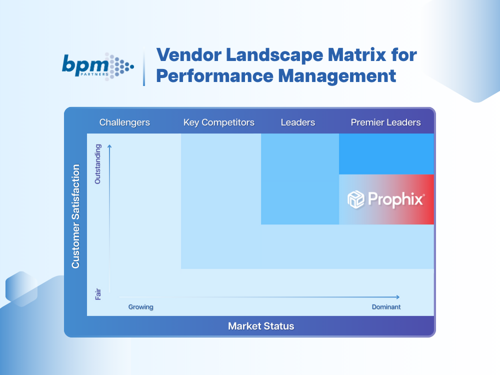
Across the full survey, Prophix earned six top-ranked positions and eight leader designations, including recognition in Self-Service, Ease of Use, and Product Satisfaction.
What this means if you’re evaluating software right now
Third-party survey data is valuable because it captures a broader cross-section of real users, not just curated references.
When 96% of a product's users report improved satisfaction, that's aggregate lived experience. When customers describe their software as "logical and easy to navigate," that's the kind of institutional knowledge that's almost impossible to fake at scale.
If you're currently evaluating financial consolidation software, a few questions worth asking any vendor, including us:
- Can you show me independent survey data, not just curated case studies?
- What does your implementation success rate look like across companies of my size?
- How do your customers rate self-service capability, specifically, how much IT involvement does ongoing operation require?
- What outcomes do your customers report around complexity reduction, auditability, and confidence in reporting?
The answers will tell you a lot.
See the full report
We're sharing this because customer feedback is genuinely how we know where to focus. The areas where Prophix scores highest are the areas our customers have told us matter most to them: usability, implementation success, support, and the ability to get real value without constant IT dependency.
The areas where we have room to grow are equally instructive. We read the full report, not just the highlights.
For finance teams still running consolidation on spreadsheets, or on legacy tools that require a specialist to open, the survey data is a useful signal: there's a category of modern consolidation software that your peers are using successfully, implementing, and recommending to others. The gap between where you are and where you could be is probably smaller than it looks.
Read the full BARC report here or talk to an expert for more information by booking a call.