
Download the CFO’s AI Roadmap
INTERCOMPANY RECONCILIATION SOFTWARE
Reconcile Intercompany.
Directly Between Entities.
Close in Days, Not Weeks.
Entities reconcile transactions directly with each other in a shared workspace. Automatic matching for routine items. See which entity pairings are complete and which need attention.
Why manual intercompany reconciliation delays the close
Manual data collection creates reconciliation delays
Entities send IC transaction files to HQ in different formats from different ERPs. HQ manually aggregates, reformats, and matches. One discrepancy requires investigating which entity's record is correct through email chains. By the time someone investigates, transactions are weeks old. Documentation is scattered across inboxes and shared drives.
No real-time visibility into IC reconciliation status
Controllers can't see which entity pairings are reconciled, which have unmatched transactions, or which are stuck without manually checking spreadsheets and emails. You discover IC isn't complete when it's too late to intervene before consolidation deadlines. IC status lives in emails and people's heads instead of a central system.
Reconciliation bottlenecks delay consolidation close
Close deadlines slip because IC reconciliation takes too long. M&A adds entities faster than manual HQ-led processes can scale. HQ becomes the bottleneck matching every transaction manually. Missing consolidation deadlines while chasing IC makes finance look unprepared. The process doesn't work but you can't fix it without slowing close even more.
What Intercompany Management makes possible
Entities reconcile IC transactions directly with each other. Automatic matching. Real-time status. HQ sees progress across all pairings. IC finishes before consolidation deadlines.
Match and Reconcile
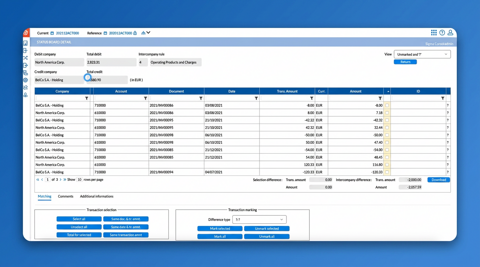
Entities reconcile their IC transactions simultaneously instead of waiting for HQ. Both sides see the same transaction list in a shared workspace. Automatic matching by document number, date, and amount. Custom rules handle exceptions. HQ monitors progress.
Collaborate and Resolve
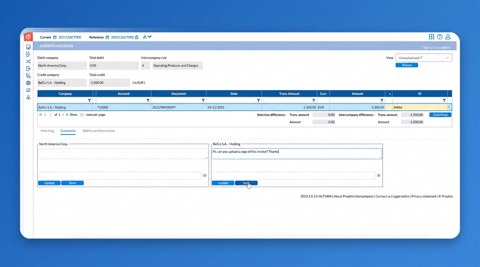
Both entities see the same transaction view with comments, attachments, and difference classifications (timing, FX, VAT, resolved, unexplained). Entities explain discrepancies while context is fresh. Approval workflows ensure both sides sign off. Complete audit trail tracks who approved, when, and why.
Monitor and Oversee
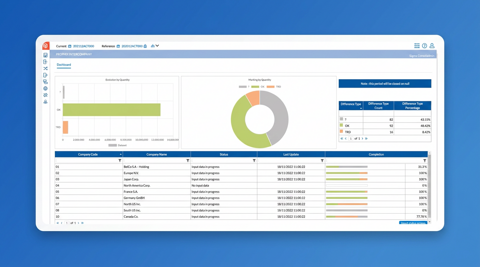
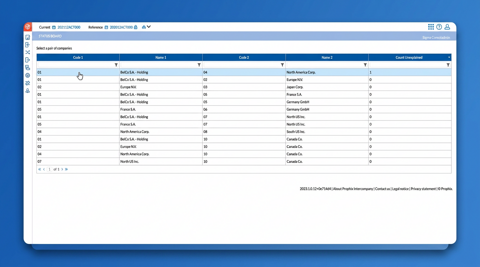
See which entity pairings are reconciled, which have unexplained differences, and which are stuck. Drill into any pairing to review transactions. Group discrepancies by account or difference type. Know whether you'll meet consolidation deadlines without chasing status updates.
Eliminate and Prepare
Reconciled IC balances automatically generate elimination journal entries that flow directly into Prophix One Financial Consolidation. Eliminations update in real time as entities complete reconciliation. Multi-currency eliminations handle FX translation automatically. Consolidation starts with clean, matched IC data.
Your path to Autonomous Finance starts here
Prophix One Intelligence flags exceptions and surfaces anomalies automatically, governed inside the platform, not bolted on. You stay in control. Finance owns the output.
Multi-entity organizations trust Prophix One for IC reconciliation
Finance teams using Prophix One Intercompany Management reconcile faster, reduce manual work, and close with confident, audit-ready IC balances.
Additional resources
Ready to see Prophix One Intercompany Management in action?
See how entities reconcile IC transactions directly, resolve mismatches at the source, and finish IC before consolidation deadlines.
Frequently asked questions
What is intercompany reconciliation and why is it required?
Intercompany reconciliation matches and validates financial transactions between legal entities within the same corporate group to ensure IC sales, purchases, loans, and transfers are recorded consistently before elimination in consolidated financial statements. Under IFRS 10 and ASC 810, IC balances must be eliminated in consolidation to prevent double-counting. Unreconciled IC creates consolidation errors and audit issues. Prophix One lets entities match transactions directly with each other instead of waiting for HQ to manually match everything.
What's the difference between intercompany and account reconciliation?
Account reconciliation validates that a GL account balance matches supporting detail from a source. IC reconciliation matches transactions between legal entities within the same group to ensure consistent recording before elimination in consolidated statements. Example: if Entity A records an IC sale of 100K to Entity B, IC reconciliation ensures Entity B recorded the corresponding IC purchase of 100K. Prophix One Intercompany Management handles IC matching, while Account Reconciliation handles balance sheet and P&L reconciliations.
How does Prophix One Intercompany Management work?
Unlike traditional approaches where HQ centrally matches all IC transactions, Prophix One lets entities reconcile directly with each other. Both entities see the same transaction list in a shared workspace. Automatic matching by document number, date, and amount. Exceptions surface immediately with comments, attachments, and difference classifications. HQ sees real-time status across all pairings. This eliminates the HQ bottleneck while maintaining oversight.
How does Prophix handle multi-currency IC transactions?
Prophix One handles multi-currency IC with automated currency conversion using period-specific exchange rates. Entities record in functional currency while HQ sees consolidated positions in reporting currency. The system converts and matches transactions across currency boundaries. Multi-currency elimination entries generate automatically with proper FX accounting per IAS 21 or ASC 830.
What happens after entities finish IC reconciliation?
Once entities complete IC matching, Prophix One automatically generates IC elimination journal entries that flow into Financial Consolidation workflows. Eliminations update in real time as entities complete reconciliation. Multi-currency eliminations handle FX translation automatically. Complete audit trail spans from entity matching through to consolidated financials.