Most finance leaders have quietly accepted the new normal.
Financial close is a long process. The business asks for numbers you don’t have yet. The board wants margin clarity, but you’re still reconciling. Your best analysts are building the same views in Excel that they built last quarter, because the process to replace that never got finished. Transformation stayed on the roadmap because the quarter didn’t wait.
Finance teams have absorbed this gap. The business keeps growing – more entities, more data, and more demands – but the team has stayed the same.
This isn’t an execution failure. It’s a structural problem that many organizations haven’t named.
The operating model never scaled
In recent years, the answer to finance capacity has been technology. And now there is added AI pressure – it's layered on top of existing technology, offered as the solution to close the gap.
But the work still sits squarely with your team. There’s a difference between giving finance teams better tools and building a finance function where there is no operational load to carry. The first is infrastructure. The second is an operating model – a System of Record that governs every number, and a System of Action where agents do the work.
We hear the term “AI transformation” a lot these days. That’s adding tools to your tech stack – a governed data layer, connectors, and a platform that your team now has to build workflows on top of. That’s not a transformation – that’s a project. And when capacity is already strapped, no one has time for that.
The right question isn’t “Which AI should we use?”
The finance teams that are pulling ahead aren’t the ones who evaluated the most vendors. They’re the ones who stopped asking “which AI should we use?” and started asking: “what should our team never have to do again?”
When you ask that question, you get an entirely different answer.
Finance teams don’t need another tool, or a platform that offers a capability labeled as autonomy.
Finance teams need an operating model – where agents handle the consolidation, close, reporting, and data readiness – and finance leads with the output, not the effort. Where the answer exists before anyone has asked for it. And where analysts are reading the numbers, not producing them.
That’s what autonomous finance means. It’s not a concept or a step on your roadmap. It’s a live operating model that is already running and ready to absorb the work that finance teams have been carrying for years.
What delegation actually looks like
That operating model isn’t theoretical. Here’s what it looks like in practice. Three new Prophix One Agents built with a single mandate: take the hardest remaining operational load off your plate.
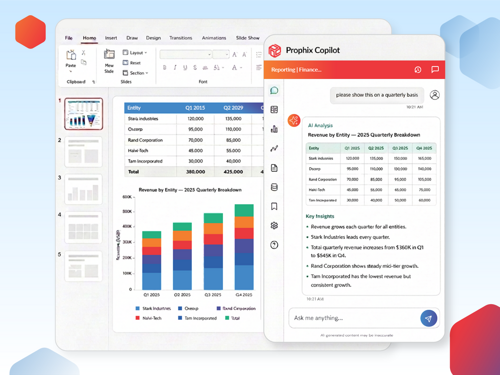
- Prophix Copilot for Microsoft Teams puts financial performance and close insights right where you work, on demand. Performance data, close status, variance analysis – delivered directly to the people who need it without routing every question through the finance team. What it displaces: the 20 to 40 ad-hoc request per week that pulls analysts off close to work to assemble a view.
- Architect Agent eliminates manual connections and set-up delay implementation. Start with clean, connected data from day one and see immediate value. What it displaces: the three-to-six-month implementation drag that keeps finance teams from realizing value before the project loses momentum.
- Prophix One Consolidation Agent runs financial consolidation so your team doesn’t have to – audit-ready, instantly, without rebuilding the same view for every stakeholder who asks. What it displaces: three-to-five days of analyst time each period, midnight close sprints, and manual intercompany reconciliations that produce competing answers,
These aren’t tools that your team configures. These are Agents running inside the System of Action – on the same System of Record that governs every number they produce.
The operating model advantage
There are two kinds of finance organizations being built right now.
The first is using AI to make existing workflows faster. The team is still in the loop – and that should remain unchanged – but they’re moving faster through processes that still require a human to prompt, input data, or direct the outputs in a time-consuming capacity.
The second has asked the harder question: what if the operational load didn’t fall on finance at all?
That’s not a vision for removing judgment from finance. It’s the opposite. Judgment, strategy, and the decisions that actually move the business still require your best people. The question is whether those people are available for that work, or whether they’re buried in the close, in the data pipeline, in the questions the business should be able to answer without them.
Here’s what most finance leaders don’t see until they’re inside it: this compounds. Tools depreciate. Operating models appreciate. Every close cycle that runs on a governed operating model makes it more accurate, more embedded, and more essential.
Agents don’t replace what finance does best. They clear the path to it.
Prophix One runs the operating model. Finance runs the business.
And the teams that move first on that distinction aren’t looking back.
The next wave of autonomous finance is here.