Artificial intelligence is no longer a future consideration for finance teams – it's a present-day imperative. But as pressure mounts to adopt AI quickly, many finance leaders are discovering that moving fast without a clear plan can create more problems than it solves: unreliable outputs, compliance headaches, skills gaps, and initiatives that stall before they deliver real value.
How do you build an AI capability that’s not just impressive on paper, but works – responsibly, governed, and at scale?
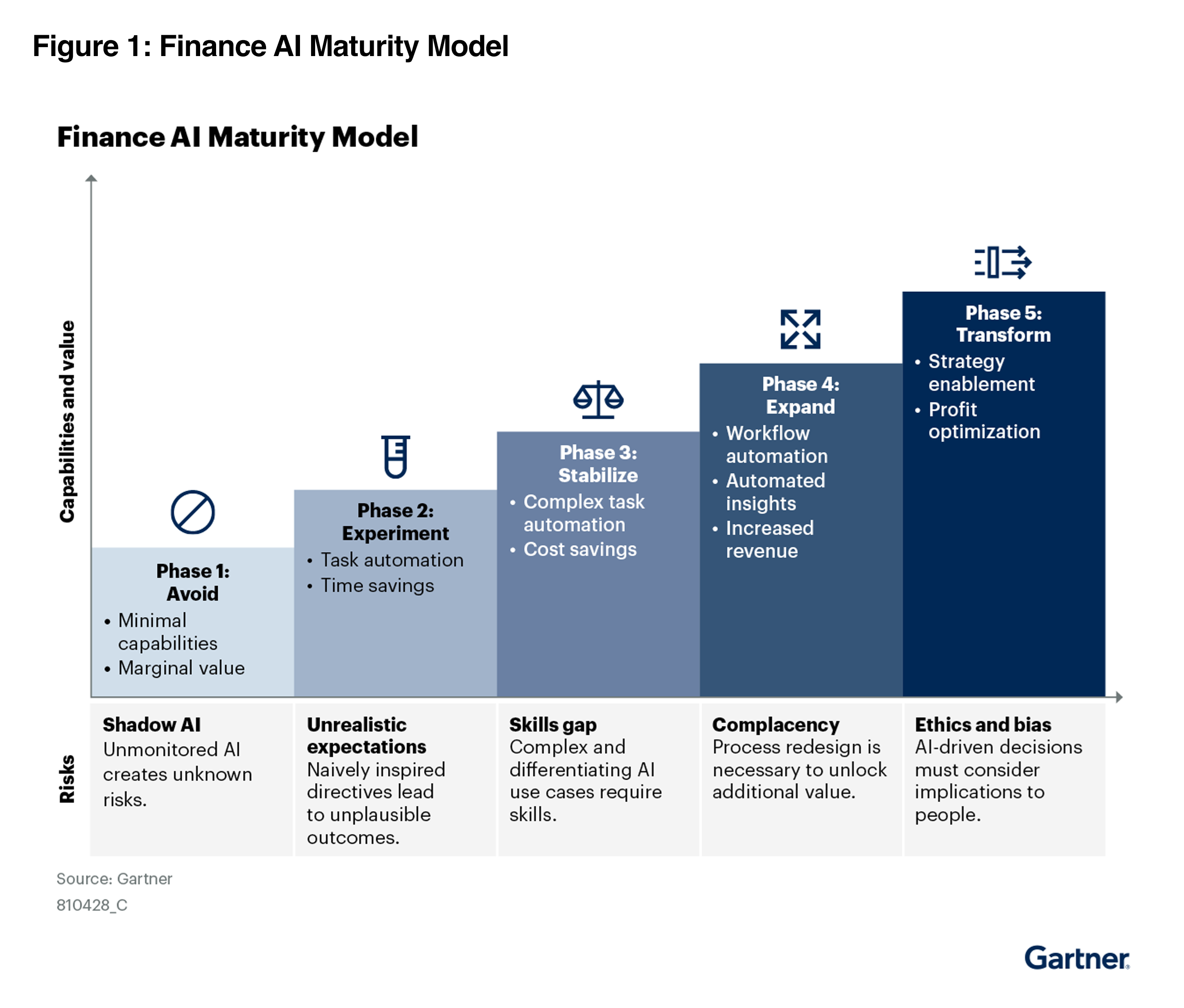
AI adoption is a journey, not a switch you flip. This Gartner research maps out five distinct phases of maturity, from organizations that are actively avoiding AI to those using it to drive enterprise-wide strategy and optimize profit.
What makes this model useful is that it doesn’t just describe where organizations end up – it helps you benchmark where you are right now and what it takes to move forward. Each phase offers new capabilities, new value, and most importantly, new risks that can unravel your progress if you’re not prepared.
Two tracks, one strategy
A core finding from the research is that the most successful finance teams don’t pick between quick wins and long-term transformation – they pursue both at the same time.
A dual-path approach to AI in finance addresses the new challenges of AI while simultaneously generating new value:
Tactical AI refers to AI embedded in purchased platforms that addresses common back-office finance operations. Tactical AI offers a relatively short-term return on investment. However, the widespread availability of these solutions offers no relative competitive benefit and fails to address the differentiating aspects of an organization’s finance processes.
Strategic AI describes customized AI-driven solutions that address the unique circumstances of a company built by an internal developed competency. Although strategic AI requires a longer-term investment in people and skills, it increases an enterprise’s long-term competitive position.
Waiting until you’ve mastered tactical AI before investing in strategic capabilities isn’t the right move – you need to run both in parallel.
It’s not just a technology problem
Technical capability is only one piece of the maturity puzzle, though.
Gartner identifies four operational dimensions that need to evolve together for AI maturity to take hold and deliver lasting value.
Culture and leadership: Culture is described as a leading indicator of success. Finance organizations with successful AI initiatives are more than twice as likely to have a high acceptance for AI in their teams. A finance organization’s culture and leadership change as maturity evolves, starting with a skeptical outlook of AI and slowly progressing toward integrating AI into operations and decision making.
Strategy and governance: Strategy and governance inform the AI roadmap developed by finance transformation leaders. As maturity progresses, strategy and governance shift from limiting AI and progress toward requiring AI to support organizational and enterprise objectives.
Skills and organization: Evolving the skills of finance teams is imperative for identifying, building and using AI-driven solutions. Over time, a transformation of skills will impact the organizational structure. The skills and organizational aspects of AI maturity start with the status quo before building and applying skills, before finally integrating AI into daily work.
Software and data: Effective AI solutions require data and software to deliver AI-driven solutions. The maturity of the AI software and data aspects in finance starts with using basic AI features in existing software platforms, progressing to custom applications that leverage a company’s strengths.
If any of these dimensions lag significantly behind the others, it can constrain overall progress – no matter how advanced the rest of the organization may be.
The stakes are high, but so is the opportunity
Finance teams that get this right save more than time and costs. Organizations that reach higher phases of AI maturity unlock capabilities, like full workflow automation or real-time scenario analysis, that would be difficult to achieve at scale without it.
This isn’t without risk. From “shadow AI” in early phases (employees using AI tools without oversight) to ethical and bias concerns at advanced levels, the report addresses what can go wrong, and more importantly, how to stay ahead of it.
If you’re ready to assess your finance AI maturity
Whether your organization is just beginning to experiment with AI or you’re looking to scale what you’ve already built, the Gartner® Finance AI Maturity Model gives you a structured, actionable framework to move ahead confidently. Download the full report to get started.
Gartner, Propel AI Capabilities with the Finance AI Maturity Model, Mark D. McDonald, 15 December 2025. GARTNER is a trademark of Gartner, Inc. and/or its affiliates.