Automation has helped finance teams reduce manual effort and improve efficiency over the past decade. But as operations grow more complex, the need for intelligent, transparent systems is accelerating. The most effective finance and accounting teams are moving beyond automating workflows and task sign-offs. They are delegating tasks, controls, and decisions to AI and machine learning.
Autonomous finance and agentic AI are distinct concepts that serve different purposes in modern finance. Understanding how they differ is essential for finance leaders making technology decisions. Autonomous finance focuses on executing tasks with minimal human input, while agentic AI introduces intelligence, reasoning, and context-aware decision-making.
Knowing where execution ends and true intelligence begins is what separates organizations making strategic, lower-risk technology investments from those adopting AI without a clear plan.
This guide explains the difference between autonomous finance and agentic AI, and why distinguishing between them is key to making the right technology investments, achieving operational clarity, managing risk effectively, and preparing for long-term growth.
Understanding Autonomous Finance: The Vision for Self-Operating Finance
Autonomous finance is a natural evolution of traditional automation. It uses AI-driven systems that operate independently to manage, execute, and optimize financial workflows with minimal human intervention. These systems operate within predefined controls and rules, ensuring consistency, predictability, and operational stability.
At its foundation, autonomous finance follows preset rules and reacts to defined scenarios. This structured approach has built the backbone of modern finance operations and set the stage for teams to adopt true intelligence and AI-driven decision-making.
To achieve true finance autonomy, teams must combine the structured execution of automation with the intelligence of agentic AI. Automation handles the what; agentic AI handles the why and the what next.
Core Processes and Capabilities of Autonomous Finance
Typical finance automation aims to reduce and remove dependence on manual control and processing, and to reduce administrative friction to boost efficiency. At the same time, typical technologies used to help to keep financial records predictable, easy to reconcile, and ready for hassle-free auditing.
Because these systems operate within predefined controls, delegated tasks still require some level of human oversight. The core processes that autonomous finance impacts include:
- Workflow automation and task orchestration, ensuring repetitive tasks are completed and distributed to the right process stages without manual intervention
- Rules-based processing, where finance tasks follow preset structures and “if-then” logic to maintain consistent, predictable results
- Financial close automation, centralizing data and automating tasks to deliver visible, accurate, and audit-ready month-end and year-end closes
- Automated reconciliations, checking, matching, and verifying financial records so balances update automatically and accurately
- Standardized reporting, pulling data automatically and presenting it in predefined templates
Benefits and Business Impact of Autonomous Finance
Autonomous finance delivers more than cost savings. It provides operational confidence and momentum to scale without sacrificing control. Organizations that implement autonomous finance see faster closes with greater accuracy, lower operational risk through reduced human error, and improved compliance and audit readiness. Governance becomes clearer, and teams gain transparency across financial workflows.
For example, ChurnZero — a leading customer success platform — needed to support its path to profitability without adding headcount. By implementing autonomous finance workflows, the team saved hours each month on report generation, scaled finance capacity without increasing team size, and empowered business leaders to run real-time scenarios and reports independently. The result: finance shifted from data crunching to strategic analysis, achieving value in weeks rather than months.
Autonomous finance provides clarity into financial operations, frees up capacity for high-value work, and builds confidence in every decision, empowering teams to support business growth.
However, automation alone does not improve the quality of decisions. That is where agentic AI comes into play.
Understanding Agentic AI: The Technology Behind the Transformation
Agentic AI is machine intelligence that can learn, reason, and make autonomous decisions beyond preset rules. It augments finance teams by accelerating insights, improving strategy, and enabling clearer, more confident decision-making. Where automation executes tasks, agentic AI understands context and determines the best course of action.
Finance teams can confidently adopt agentic AI by choosing the right tools, applying proper guardrails, and maintaining oversight where it matters most. The best agentic AI systems are built around trust, governance, and controlled autonomy, enhancing decision-making with human oversight built into the process rather than bolted on after the fact.
Key Technologies and Components of Agentic AI
When supported by high-quality data and mature finance processes, agentic AI handles and acts on a wide variety of critical tasks. It also explains its decision-making process, giving teams full transparency into its conclusions and the ability to refine its outputs over time.
The most effective agentic AI systems support “human-in-the-loop” setups, where personnel can step in to manage and oversee decision-making. This is particularly valuable during early stages of deployment.
Core agentic AI technologies and components include:
- Autonomous agents that handle contextual, low-level tasks previously reserved for human personnel
- Machine learning models that understand your specific processes and improve over time through experience and feedback
- Scenario modelling that creates detailed forecasts for specific budgeting and expenditure situations, supporting more informed decisions
- Contextual reasoning engines, the key differentiator from autonomous finance, where AI makes scenario-based decisions drawn from the reasoning it has been trained on
- Cross-system decision capabilities, where AI takes coordinated actions across integrated software and platforms
Benefits and Business Impact of Agentic AI
With responsible governance and guardrails, agentic AI is a clear competitive advantage for finance and accounting teams. It delivers measurable, outcome-focused results:
- Faster forecasting cycles built on intensive learning and deep data analysis, enabling teams to act decisively
- Accelerated scenario planning and strategy development, reducing the time between analysis and action
- Proactive risk identification that flags issues before they escalate, shortening feedback cycles and reducing trial and error
- Decision preparation and recommendations that give finance leaders unbiased, data-driven options while keeping accountability where it belongs
- Significant reduction in manual, repetitive work, freeing teams to focus on strategic priorities and higher-value projects
Key Differences: Autonomous Finance vs. Agentic AI
Autonomous finance handles routine tasks with stability and consistency. Agentic AI goes further: it makes context-aware decisions, accelerates workflows, and gives finance teams the clarity and confidence to act strategically.
Autonomous finance and agentic AI serve different purposes but work together to transform finance operations. Autonomous finance handles core tasks reliably, creating a structured foundation that allows agentic AI to make intelligent, context-aware decisions with speed and precision.
Crucially, agentic AI is the capability, while autonomous finance is the outcome: it is what happens when agentic AI systems are effectively put to work.
Here’s a quick breakdown of the differences between autonomous finance and agentic AI.
Key Difference | Autonomous Finance | Agentic AI |
Business Value | Automates manual tasks to free capacity and ensure workflows move along at the pace expected | Decides on actions to take within workflows, and explores and sifts complex data to build more reliable forecasts and audit-ready closes |
Proactivity and Decision-Making | Reacts based on tasks and templates set for it, based on set schedules and rules | Anticipates tasks and makes decisions with human oversight |
Contextual Understanding | Understands its core tasks within the instructions and boundaries humans set for it, but cannot think for itself | Based on training and self-improvement, learns the context and urgency of tasks and interprets goals |
Scope | Typically used to manage end-to-end processes and manual tasks | Can investigate accounts, find anomalies, make suggestions, reconcile figures, and build forecasts |
Adaptability | Confined to the tasks and instructions you set for it (and won’t act beyond these boundaries) | Makes independent decisions, learns, and builds insight through delegation and training |
Organizations that combine autonomous finance with agentic AI gain both operational efficiency and decision-making intelligence. Autonomous finance keeps the engine running; agentic AI ensures it is running in the right direction. Together, they position finance and accounting teams to be more insightful, responsive, and competitive.
Comparison with Traditional Automated Finance
Traditional or legacy automation, built around spreadsheets and manual workflows, is no longer sufficient for modern finance management. Legacy systems that rely on manual or traditional data pulling, for example, are at higher risk of making mistakes compared to modern AI, which learns and adapts the more you work with it.
Traditional automation follows fixed rules and is often reliant on data sourced from manual silos and spreadsheets. This makes it costly and time-consuming to manage and maintain, which slows down businesses looking to scale.
Legacy systems are prone to data bottlenecks and cannot sift anomalies and silos on their own - and the more complex data becomes, the more time finance and accounting teams need to put into cleaning information and training said systems.
Modern AI in finance, however, grows and adapts with companies’ financial demands as they grow. Agentic AI, while still requiring some human oversight, can be relied upon to interpret data and make decisions on your behalf, even as your income and expenditure grow, and as your operations scale.
Real-World Use Cases of Autonomous Finance and Agentic AI
Autonomous finance and agentic AI work together in practice. Autonomous systems ensure finance teams meet reporting KPIs, pull relevant data, and maintain oversight of workflows. Agentic AI builds on that foundation, adding intelligence and context to every process.
Adopting agentic AI is a phased process, not an overnight switch. Teams start by establishing reliable automated workflows, then layer in intelligence as data quality improves and confidence grows. Over time, agentic AI can be applied to increasingly complex tasks:
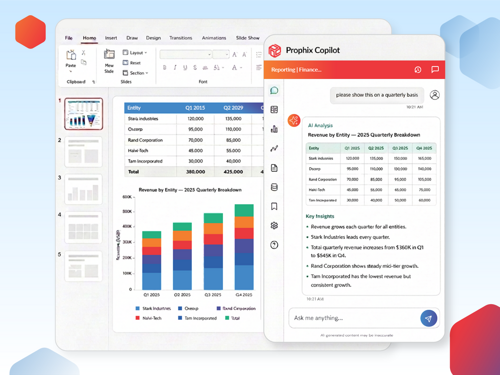
- Act as a financial copilot, trained on your data to answer questions about performance, trends, and exceptions in real time
- Manage monthly and yearly closes end-to-end through accurate reconciliation, data refinement, and automated report production, reducing close times and improving accuracy
- Generate multiple financial forecasts based on current data, spending precedents, and income trends, giving teams faster, more confident scenario planning
- Produce on-demand visuals and summaries to answer stakeholder questions during meetings, reducing preparation time
- Identify data anomalies and trends of concern, explaining them in plain language so teams can act immediately
The Future of Finance and the Evolving Role of Finance Teams
Thanks to the evolution of agentic AI and autonomous finance, finance teams are spending less time on manual execution, and more on actively interpreting data and building strategies. AI isn’t replacing people, rather, it’s augmenting them, allowing accounting and finance experts to own their data outcomes and governance.
Agentic AI is handling the execution, while personnel are taking greater responsibility for oversight, training, and what teams do with the data that’s processed.
Finance teams that move beyond basic automation and leverage agentic AI gain the clarity, speed, and confidence to make smarter decisions and respond more effectively to changing business conditions. The opportunity is here now, and the teams that act on it will be the ones setting the pace.
Conclusion: Choosing Between Autonomous Finance and Agentic AI
Finance teams gain the most from AI when they go beyond basic automation. While automation manages routine tasks, agentic AI actively supports reporting, data reconciliation, and audit readiness—giving teams clarity, capacity, and confidence in their decisions.
Book a call with our team and learn more about how Prophix One can help keep your finance team efficient, competitive, and focused on the tasks that matter most.