Cash flow forecasting software predicts how much cash a business will have over a set horizon such as 13 weeks or 12 months, by pulling actuals from your ERP, accounting, and banking systems and modelling inflows and outflows on one connected set of numbers.
Each tool on this list is framed as best for a specific type of team and anchored to third-party ratings: Gartner Peer Insights for the tools with real review depth there, and G2 for the treasury and AR tools where Gartner's cash-flow market is thin. Prophix One leads the mid-market segment on platform breadth and honest ratings.
The right choice depends on your company size, your accounting and ERP stack, whether you need short-term liquidity tracking or long-range planning, and whether cash forecasting should stand alone or connect to your budgeting and close.
Cash flow forecasting is where profit meets reality. A business can be profitable on paper and still run out of cash, which is why finance teams treat the forecast as a core planning tool rather than a monthly report. This guide compares 13 tools built to do that work, each framed for the team it fits best and rated against independent third-party data rather than our opinion.
Our list shows every tool's honest rating, names the segment each one serves, and gives even-handed pros and cons so you can match a tool to your situation. Where a tool is strong, we say so. Where reviewers flag a limitation, we say that too.
Here are the 13 tools, ordered by use-case fit rather than a ranking.
Best cash flow forecasting software tools for 2026
#
Tool
Best for
Rating (source)
1
Prophix One
Mid-market teams that want cash forecasting connected to planning and close
4.4 / 5 (270), Gartner
2
Vena
Excel and Microsoft 365-native teams
4.6 / 5 (338), Gartner
3
Anaplan
Large-enterprise connected planning at scale
4.5 / 5 (374), Gartner
4
Planful
Mid-market to enterprise integrated FP&A and cash
4.4 / 5 (225), Gartner
5
OneStream
Enterprises unifying CPM on one platform
4.6 / 5 (378), Gartner
6
Kyriba
Enterprise treasury and liquidity
4.5 / 5 (119), G2
7
HighRadius
AR-driven cash forecasting at enterprise scale
4.3 / 5 (233) , G2
8
Abacum
Collaborative mid-market planning
4.6 / 5 (47), Gartner
9
Datarails
Excel-based reporting and consolidation
4.6 / 5 (359), G2
10
Pigment
Driver-based collaborative modelling
4.7 / 5 (225), Gartner
11
Jirav
SMB and accounting-firm forecasting
4.7 / 5 (191), G2
12
Float
SMB accounting-native cash forecasting
4.4 / 5, G2
13
Tesorio
AR and collections-led cash forecasting
4.7 / 5 (231), G2
Ratings are all-time averages with review counts in parentheses. Gartner ratings are from the Financial Planning Software market on Gartner Peer Insights. Treasury and AR tools, and tools not covered in a relevant Gartner market, are rated with G2 and marked accordingly. Each tool's block below lists its G2 rating as a second independent source; the table stays on one scale for comparability.
How we evaluated these tools
We anchored every tool to independent third-party data rather than our own scoring, and we were deliberate about which source to use for which tool, because cash flow forecasting spans two very different software categories.
The FP&A and planning platforms are covered in the Gartner Financial Planning Software market, which rates vendors through verified customer reviews with real depth, many with hundreds of reviews per vendor. The dedicated treasury and AR tools sit in Gartner's separate Cash Flow Management market, which exists but currently has very thin review volume, in some cases only a handful of reviews per vendor. A rating built on three or four reviews is not a reliable signal, so for those tools we use G2, where the same vendors carry a substantial review base. Every tool also shows its G2 rating in its block as a second source.
The criteria we used to frame each tool follow how buyers actually evaluate cash flow forecasting software:
Forecasting core: direct and indirect methods, short-term liquidity tracking, and rolling forecasts.
Data integration: connections to ERP, accounting, banking, and other source systems for real-time data access.
Modelling and scenarios: driver-based modelling, what-if analysis, and scenario planning.
Scope: cash forecasting alone, or cash connected to budgeting, planning, and financial close.
Fit by company size and stack: SMB, mid-market, or enterprise, and multi-entity or multi-currency needs.
Ordering reflects use-case fit for a mid-market finance buyer, not rating rank. A tool with a higher average rating can sit lower because it serves a different segment, and the "best for" label tells you which team each one fits.
1. Prophix One: Best for mid-market teams that want cash forecasting connected to planning and close
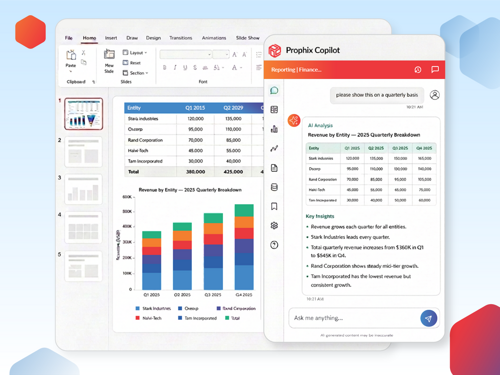
Many mid-market finance teams forecast cash in a spreadsheet that sits apart from their budget, their plan, and their close, which means reconciling numbers before the forecast can be trusted. Prophix One is a Financial Performance Platform that unifies budgeting, forecasting, reporting, financial consolidation, and cash management in one environment, so the cash forecast draws on the same numbers as the rest of finance. Teams build 13-week and longer cash forecasts, model what-if scenarios, and see liquidity trends on real-time dashboards. Prophix One Intelligence automates data preparation and surfaces the drivers behind a cash position for review, with high-volume work handled automatically, exceptions routed to the team, and finance keeping oversight of every result. It is a glass-box approach, where you can trace how a number was produced.
Key features: Direct and indirect cash flow forecasting, 13-week cash planning, scenario and what-if modelling, budgeting and planning, financial consolidation, real-time liquidity dashboards, Prophix One Intelligence for automated data preparation.
Pros: Cash forecasting connected to planning and close in one platform, so mid-market teams avoid running a separate treasury tool; established review base relative to newer entrants; strong reviews for customer support and onboarding.
Cons: As a full platform rather than a single-purpose cash tool, Prophix One rewards a proper implementation to get the most from it, and reviewers note that building assumption-driven balance sheet and cash flow statements can require care to keep processing efficient.
Gartner Peer Insights: 4.4 / 5 from 270 reviews.
G2: 4.4 / 5 from 219 reviews.
Pricing: Quote-based.
Customer outcome: View Point Health, a behavioural health organisation serving four Georgia counties east of Atlanta, deployed Prophix One FP&A Plus and Cash Management. It cut a three-hour overnight reporting cycle to under a minute, gave 40 non-finance users live, self-serve access to financials they once waited on in monthly reports, and scaled from $50M to $70M without adding a financial analyst. Under CFO Eric Naughton, the lean, accountant-led finance team redirected that time from producing reports to analysis.
"With Prophix Copilot it essentially gives every one of my program directors their own personal financial analyst. Prophix didn't just share an AI vision, they delivered on it."
Eric Naughton, CFO, View Point Health
2. Vena: Best for Excel and Microsoft 365-native teams
Vena delivers cash flow planning on a managed database while keeping a native Excel interface, and integrates across Microsoft 365. Teams build direct and indirect cash flow models, bring existing Excel statements in, and run them monthly, weekly, or daily.
Key features: Native Excel front end, centralised database, direct and indirect cash flow modelling, scenario planning, Microsoft 365 integration, workflow.
Pros: Familiar Excel experience lowers the adoption barrier; strong fit with the Microsoft stack; structured workflows for planning cycles.
Cons: Reviewers note a learning curve on advanced features, and that very large models can be slower to load.
Gartner Peer Insights: 4.6 / 5 from 338 reviews.
G2: 4.5 / 5 from 476 reviews.
Pricing: Quote-based.
3. Anaplan: Best for large-enterprise connected planning at scale
Anaplan is a cloud platform for enterprise planning that models cash flow alongside finance, supply chain, and sales in one connected environment. Its calculation engine handles large, multi-dimensional models, importing AR and AP data with historical actuals for granular cash forecasting.
Pros: Powerful, flexible modelling that scales to enterprise complexity; connects cash planning across functions.
Cons: Reviewers note a steep learning curve and a reliance on skilled model builders, and cost that scales with the deployment.
Gartner Peer Insights: 4.5 / 5 from 374 reviews.
G2: 4.6 / 5 from 461 reviews.
Pricing: Quote-based.
4. Planful: Best for mid-market to enterprise integrated FP&A and cash
Planful supports cash flow planning alongside budgeting, forecasting, reporting, and consolidation, tracking inflows and outflows across the P&L and balance sheet with driver-based assumptions for short and long-term views.
Pros: Covers cash, planning, and close in one platform; structured processes that suit finance-led deployments.
Cons: Reviewers note that implementation can be involved, and that formatting complex reports takes some effort.
Gartner Peer Insights: 4.4 / 5 from 225 reviews.
G2: 4.3 / 5 from 501 reviews.
Pricing: Quote-based.
5. OneStream: Best for enterprises unifying CPM on one platform
OneStream unifies planning, cash forecasting, close, consolidation, and reporting for large organisations that want one platform across corporate performance management, consolidating data from many sources.
Key features: Unified planning and cash forecasting, financial close and consolidation, reporting, analytics, Excel add-in.
Pros: Enterprise-grade breadth and scalability; reduces the number of separate CPM tools a large finance function runs.
Cons: Reviewers note a learning curve on some capabilities, and that the platform can be more than a mid-market team needs.
Gartner Peer Insights: 4.6 / 5 from 378 reviews.
G2: 4.6 / 5 from 160 reviews.
Pricing: Quote-based.
6. Kyriba: Best for enterprise treasury and liquidity
Kyriba is a cloud treasury management system that unifies cash management, payments, risk, and cash forecasting, connecting to thousands of banks for real-time cash positions across accounts, entities, and currencies. It is built for treasury teams at mid-market and enterprise organisations.
Key features: Real-time cash positioning, bank connectivity, cash forecasting, payment automation, risk management, scenario and stress testing.
Pros: Deep treasury functionality and global bank connectivity; strong for consolidating forecasts across many entities and banking relationships.
Cons: Reviewers note that implementation can be long and involved, and that the depth of the platform brings a learning curve.
G2: 4.5 / 5 from 119 reviews. Gartner's Cash Flow Management market lists Kyriba but with too few reviews to be a reliable rating, so G2 is the source here.
Pricing: Quote-based.
7. HighRadius: Best for AR-driven cash forecasting at enterprise scale
HighRadius is an order-to-cash and treasury platform whose strength is the AR data that feeds a cash forecast. Its treasury and risk product delivers cash positioning, ML-based category forecasting, and bank connectivity, and it suits receivables-heavy enterprises that want forecasting built on clean AR and AP data.
Key features: AR and AP-driven cash forecasting, ML category models, cash positioning, bank and ERP connectivity, scenario and variance analysis.
Pros: Strong AR automation feeding forecast accuracy; deep ERP integrations; built for high-volume, receivables-heavy organisations.
Cons: Reviewers note that implementation and configuration can be time-consuming, that some processing is batch rather than real time, and that pricing is geared toward larger organisations.
G2: HighRadius Accounts Receivables, the AR engine behind the forecast, rates 4.3 / 5 from 233 reviews on G2. The standalone Treasury and Risk cash product is newer and thinly reviewed on both G2 (single digits) and Gartner, so there is no reliable product-specific rating for it yet.
Pricing: Quote-based.
8. Abacum: Best for collaborative mid-market planning
Abacum is an FP&A platform that connects to accounting and CRM systems and lets finance teams model cash inflows and outflows by customer, region, or business unit, with strong collaboration so department heads contribute inputs.
Key features: Collaborative cash and financial modelling, real-time data consolidation, scenario analysis, cash runway and burn tracking, reporting.
Pros: Modern, collaborative experience with a fast path to value for mid-market teams; good visualisation of runway and financing needs.
Cons: Reviewers note a smaller review base than the established platforms, and that it fits mid-market needs better than the smallest teams.
Gartner Peer Insights: 4.6 / 5 from 47 reviews.
G2: 4.8 / 5 from 143 reviews.
Pricing: Quote-based.
9. Datarails: Best for Excel-based reporting and consolidation
Datarails is an Excel-connected FP&A platform that consolidates bank and ERP data for cash forecasting while keeping finance teams in the spreadsheet, with drill-downs by account, department, or currency and version control on forecasts.
Key features: Excel-native interface, bank and ERP consolidation, cash forecasting, scenario planning, version control, dashboards.
Pros: Works within Excel; strong for consolidation and reporting across many source systems.
Cons: Reviewers note a learning curve on complex models, and that database, workflow, and collaboration features are lighter than some similarly priced tools.
G2: 4.6 / 5 from 359 reviews. Not rated in a relevant Gartner market.
Pricing: Quote-based.
10. Pigment: Best for driver-based collaborative modelling
Pigment is a modern business planning platform with visual, driver-based modelling that connects financial statements for a real-time view of cash inflows and outflows, integrating source systems and automating data imports.
Pros: Intuitive, flexible modelling with a strong collaboration experience.
Cons: Reviewers note it is a newer platform with a learning curve, and that it can be slower on very large data sets.
Gartner Peer Insights: 4.7 / 5 from 225 reviews.
G2: 4.6 / 5 from 106 reviews.
Pricing: Quote-based.
11. Jirav: Best for SMB and accounting-firm forecasting
Jirav is a cloud FP&A platform for small and mid-sized businesses and accounting firms, with driver-based three-statement models that tie revenue, expenses, and headcount to cash flow, plus dashboards and accounting integrations.
Key features: Driver-based three-statement modelling, rolling cash forecasts, dashboards, integrations with QuickBooks, Xero, NetSuite, and HR systems.
Pros: Strong driver-based forecasting and visual reporting; fast onboarding; publishes list pricing, which is unusual for the category.
Cons: Reviewers note a learning curve for advanced models and some limits on multi-entity reporting.
G2: 4.7 / 5 from 191 reviews. Not rated in a relevant Gartner market.
Pricing: Quote-based (Jirav also publishes list tiers on its site).
12. Float: Best for SMB accounting-native cash forecasting
Float is purpose-built for cash flow forecasting and works as an add-on to small-business accounting systems. It builds daily, weekly, and monthly forecasts, tracks invoices and bills, and projects short-term cash runway.
Key features: 13-week rolling forecasts, cash runway projections, basic scenario modelling, integrations with Xero, QuickBooks Online, and FreeAgent.
Pros: Simple, quick to set up, and pulls accounting data automatically for a clear short-term liquidity view.
Cons: Reviewers note it is built for short-term forecasting rather than deep FP&A, and that it fits smaller teams more than complex, multi-entity organisations.
G2: 4.4 / 5 [verify count at publish]. Not rated in a relevant Gartner market.
Pricing: Quote-based (Float also publishes pricing on its site).
13. Tesorio: Best for AR and collections-led cash forecasting
Tesorio automates cash flow management with a focus on accounts receivable and collections, integrating with ERP and accounting systems to predict receivables and payables and help finance teams manage working capital.
Key features: AR automation, cash forecasting, collections management, working-capital insights, ERP and accounting integrations.
Pros: Strong for receivables-led forecasting and collections; reviewers highlight an intuitive interface and responsive support.
Cons: Reviewers note it is focused on the AR and collections side of cash rather than full FP&A planning.
G2: 4.7 / 5 from 231 reviews. Gartner's Cash Flow Management listing has no reviews, so G2 is the source here.
Pricing: Quote-based.
Others worth a look, depending on your stack and size: Workday Adaptive Planning for teams standardised on Workday, Drivetrain and Centage for finance-owned mid-market forecasting, Cube for spreadsheet-native teams, Fathom for advisor and small-business reporting, and Agicap, Nomentia, and Trovata on the treasury side.
What is cash flow forecasting software?
Cash flow forecasting software predicts how much cash a business will have over a defined horizon such as 13 weeks or 12 months, by pulling actuals from source systems and modelling expected inflows and outflows. It is not the same as cash management software, which monitors and controls the cash a company has now. Forecasting looks forward: it relies on historical data plus expected income and expenses, including cash receipts, cash payments, and operating transactions, to project the future cash position.
The software connects to your ERP, accounting software, and banks, replaces manual spreadsheet consolidation with automated data preparation, and gives finance dashboards and reports to plan ahead. Broader FP&A and CPM platforms extend forecasting into budgeting, planning, and financial close, so the cash forecast draws on the same numbers as the rest of finance. Dedicated treasury tools focus on bank connectivity, liquidity, and payments, and AR-led tools build the forecast from receivables data.
For related background, see these Prophix resources:
Beyond the projection itself, the features that separate a capable cash flow forecasting tool are the ones that keep the forecast accurate, current, and shareable. Look for these when you evaluate:
Automated cash flow calculations and data integration: Real-time connections to ERP, accounting, and banking systems so the forecast reflects current numbers without manual entry.
Cash position tracking: A live view of cash across accounts and entities.
Scenario modelling and predictive analytics: Driver-based models and what-if analysis to test assumptions, with AI-assisted prediction where the data supports it.
Customised cash flow models: Direct and indirect methods, and the flexibility to model your own drivers.
Interactive dashboards and financial reporting: Board-ready views and variance analysis to explain the forecast.
Collaboration and role-based access controls: Shared inputs from across departments with appropriate permissions and audit trails.
Benefits of cash flow forecasting software
Moving from spreadsheets to dedicated software changes cash forecasting from a slow, manual chore into a real-time planning capability. The benefits reported most consistently:
Forecast accuracy: Automated actuals and predictive models reduce the errors that come with manual data entry.
Real-time data integration and cash flow visualisation: A live cash position and clear dashboards instead of a forecast that is stale by the time it is finished.
Liquidity planning and risk management: Earlier visibility into shortfalls and surpluses, and the ability to model risk with scenario planning.
Data centralisation and collaborative inputs: One source of numbers, with inputs gathered from across the business.
Strategic decision-making: Time redirected from preparing the forecast to acting on it, with financial modelling that connects cash to the broader plan.
Cash flow forecasting in spreadsheets vs dedicated software
Most teams start cash forecasting in Excel or Google Sheets, and for a small business with a simple model and few data sources, that can be enough. Spreadsheets are flexible, familiar, and cheap. The problem is that they do not integrate with your ERP, accounting, banking, and payroll systems, so every update means exporting and aggregating data by hand.
That manual data entry introduces human error and takes so long that the forecast can be out of date by the time it is done. Version control breaks down across a team, large data sets slow performance, and scenario modelling is hard to build and maintain. Dedicated software addresses these through automation of data consolidation, real-time data integration, cloud-based collaboration, and customisation that scales, which is why teams tend to move off spreadsheets as their cash flows grow more complex, span more entities, or touch treasury management.
The honest test: if your model is simple and single-entity, a spreadsheet can serve you well for now. Once you are chasing data across systems, managing multiple entities or currencies, or reforecasting often, dedicated software earns its cost.
Types of cash flow forecasting and common challenges
There are two main forecasting methods, and the right one depends on your time horizon. The direct method works from actual operating transactions, cash receipts and payments, and suits short-term projections, such as 13 weeks or less, for day-to-day liquidity. The indirect method starts from net income on the P&L and adjusts for non-cash items and balance sheet changes, and suits longer-range planning, up to a few years. Many teams run both, and stronger platforms support each.
Even with good software, cash forecasting faces recurring challenges: data inaccuracies from incomplete or disconnected sources, seasonality shifts and volatility that make patterns hard to predict, and shifting market conditions that can disrupt a forecast. Enterprise-level platforms add the challenge of multi-entity and multi-currency consolidation, and complex models can create a reliance on IT support. Software mitigates these with real-time integration, scenario planning, and what-if analysis, but the forecast is only as good as the data and the assumptions behind it, which is where finance judgment stays essential.
How to choose the best cash flow forecasting software
The best cash flow forecasting software is the one that fits your company size, your stack, and the scope of work you need it to cover. Company size is the most reliable first filter, because enterprises, mid-market companies, and small businesses have genuinely different needs.
Enterprises deal with cash across multiple entities, currencies, and intercompany flows, large data volumes, and regulatory and audit compliance. They need multi-entity and multi-currency consolidation, high performance, role-based access, and enterprise-grade security. Anaplan, OneStream, Kyriba, and HighRadius fit here.
Mid-market companies run smaller finance teams that chase data across departments and need frequent, flexible forecasting without heavy technical overhead. An intuitive, finance-owned platform matters most. Prophix One, Vena, Planful, and Abacum fit here.
Small businesses need effective forecasting without complexity, with easy accounting integrations and short-term liquidity tracking. Jirav, Float, and a well-built spreadsheet fit here.
Across all three, weigh the same factors: how easily the tool integrates with your existing systems, ease of use for the people who will actually use it, real-time data updates, scenario planning depth, growth objectives and business complexity, and total cost. Most vendors are quote-based, so compare implementation effort and ongoing administration, not just license price. And decide who will own the model: some platforms are built for finance to run independently, while others rely on IT or consultants.
AI and the future of cash flow forecasting
AI is changing cash forecasting from a static, assumption-heavy exercise into a faster, more adaptive one, but the useful question is not whether a tool has AI, it is what the AI does and how much control finance keeps.
The applications delivering real value today cluster around a few jobs. Machine learning models build baseline forecasts from historical patterns and live data, then keep adjusting as new data arrives. Automated predictive forecasting and cash flow trend analysis point analysts to what is changing. Integrated anomaly detection reviews high volumes of transactions and routes the ones that look off to a person to confirm. And natural language queries let a finance user interrogate a forecast without building a report.
The pattern that fits a finance function is consistent: the software handles the high-volume, repeatable work and surfaces exceptions to the team, and finance keeps oversight of the output. Two conditions decide whether AI delivers. The data has to be clean and connected, because a forecast built on messy inputs will not hold up. And the logic should be visible rather than a black box, so finance can stand behind the number that goes to leadership. Used this way, AI shortens forecast cycles and sharpens accuracy while accountability stays with the people who sign off on the plan.
Cash flow forecasting: Predicting a company's future cash position over a set horizon using historical data and expected inflows and outflows.
Cash management: Monitoring and controlling the cash a business currently holds, as distinct from forecasting future cash.
Direct method: A short-term forecast built from actual cash receipts and payments.
Indirect method: A longer-range forecast built from net income adjusted for non-cash items and balance sheet changes.
13-week cash flow forecast: A rolling short-term view of liquidity, common for operational cash management.
Rolling forecast: A forecast that updates on a regular cadence and always looks a set number of periods ahead.
Liquidity: The cash and near-cash a business can access to meet obligations.
Scenario planning: Modelling multiple sets of assumptions side by side to compare outcomes.
Driver-based modelling: Building a forecast from operational drivers, such as collections timing or headcount, rather than prior-period figures alone.
Multi-entity and multi-currency consolidation: Combining cash positions across legal entities and currencies into one view.
Frequently asked questions
What is the difference between cash flow forecasting and cash management software?
Cash management software handles day-to-day cash management: it monitors and controls the cash you hold now, including live cash position tracking across accounts and banks. Cash flow forecasting software looks forward, predicting how much cash you will have over a horizon such as 13 weeks or 12 months from historical data and expected inflows and outflows.
How does cash flow forecasting software integrate with accounting software?
It connects to your accounting or ERP system through direct APIs or middleware and pulls transactions automatically. Integration with accounting software is the first thing to check, because it is what gives the forecast real-time data instead of stale exports. Many tools add AI consolidation of banking transactions, automatically matching and categorising bank activity and routing only the exceptions to the team for review.
How does cash flow forecasting support budgeting and scenario planning?
The cash forecast is an input to broader budgeting and scenario planning. Financial modelling in the software lets you test how a decision, such as hiring, entering a new market, or a delayed receivable, changes the cash position, which turns the forecast into a tool for strategic financial planning rather than a static report.
How do I migrate from spreadsheets to cash flow forecasting software?
Migration from spreadsheets starts by connecting your accounting, ERP, and banking systems so actuals flow in automatically, then rebuilding your existing model in the tool. For a small, single-entity business with a simple model, a spreadsheet can still be enough. Teams migrate once manual data entry and version control become the bottleneck.
How much does cash flow forecasting software cost?
Most vendors price by quote, based on company size, users, modules, and data complexity, and some SMB-focused tools publish list tiers. Factor in implementation and ongoing administration, not just the license.
Which cash flow forecasting software is best for mid-market finance teams?
Mid-market teams commonly evaluate Prophix One, Vena, Planful, and Abacum. Prophix One is built for mid-market teams that want cash forecasting connected to budgeting, planning, and financial close in one platform.
See a unified platform in action
If your team forecasts cash in one place and plans and closes the books in another, Prophix One brings budgeting, forecasting, reporting, consolidation, and cash management together so you work from a single set of numbers, with automation that keeps finance in control of every result. See how View Point Health gave 40 users live access to their financials and scaled without adding headcount. Book a demo or explore our Cash Flow Planning solution.