AI is reshaping the way finance teams and leaders build and adjust forecasts amid volatile environments. With careful implementation and human governance, AI financial forecasting is more efficient, accurate, and insightful than the manual alternative.
In this guide, we explore the broader benefits of AI-enabled forecasting, use cases, real-world case studies, and best practices for implementing it across your own workflows and processes.
What Is AI in Financial Forecasting?
AI in financial forecasting processes large datasets in real time to surface patterns and correlations that would take manual processes significantly longer to identify. With clean, standardised data and well-designed workflows, AI can generate forecasts and scenario models faster and at greater depth than spreadsheet-based processes allow.
Traditional forecasting methods that rely on manually entering and pulling data from spreadsheets are slow and leave room for inaccuracies.
Instead, finance teams use AI to read, analyse, and build predictions, allowing them to move from fixed annual forecasts to rolling models that update continuously.
This is achieved through a broad variety of AI technologies, including:
Machine learning: This technology allows AI models to learn from large sets of data without needing instructions, continually improving on specific tasks. In financial forecasting, machine learning could allow an AI tool to better understand your organisation’s expenses after being trained on years of budgets.
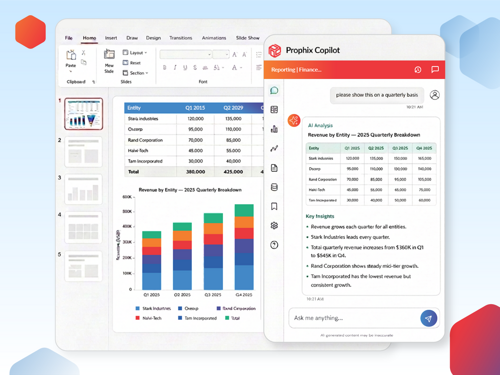
Natural language processing: This lets AI tools interpret financial documents, generate variance narratives, summarise reports, and respond to natural language queries about forecast data.
Predictive modelling: By being fed historical data, AI tools can create predictive models (like forecasts) that take existing trends into account. This can dramatically accelerate your own forecasting.
Generative AI: Fed data like images, written text, and more, this technology gives an AI tool the ability to generate content based on user prompts.
Conversational AI: Tools like ChatGPT use large language models to interpret natural-language inputs and generate responses, giving users an accessible interface for querying information, drafting content, or exploring scenarios without technical expertise.
Large language models: This technology generates responses by predicting likely sequences of language based on patterns learned during training—not by retrieving answers from a fixed database.
Benefits of AI Adoption and the Challenges Finance Teams Face
While the benefits of AI adoption for forecasting include improved accuracy and automated variance analysis, some finance teams face barriers to adopting and implementing the technology. However, these barriers can be overcome with careful planning and rollout.
Given that AI can process large, complex datasets, it notably improves forecast accuracy. Its ability to sweep data at high speed, too, means finance teams cut considerable data preparation time.
AI automates variance detection and exception routing, meaning teams are freer to focus on actively analysing and strategising with the insights it provides, and spend less time managing data manually.
However, there are several common implementation challenges:
- Data fragmentation across multiple systems and ERPs is one of the most common barriers to reliable AI outputs. Centralising and standardising data before rollout gives automation the clean foundation it needs to deliver accurate results.
- A successful rollout depends on treating change management as workflow redesign, not a technology adoption exercise. When finance teams are involved from the start and training is phased gradually, confidence builds alongside capability.
- Integrating multiple ERPs and systems introduces complexity early in a rollout, which is why choosing a platform with established connectors and a single source of record for finance data is a critical early decision rather than an afterthought.
- Compliance standards require transparent, explainable audit trails for any automated action that touches the close or reporting. Glass-box AI meets that requirement by default, giving finance, auditors, and leadership a traceable record of every decision.
How AI Changes Financial Planning and Decision-Making
Introducing AI to financial planning and analysis creates a strategic shift - in particular, finance teams move from being reactive reporters to proactive planners. Having access to rolling, real-time forecasting data means experts can analyse and strategise faster and more frequently.
What’s more, finance teams can use rolling forecasts to build scenario outputs that reach decision-makers faster.
Planning cycles are shorter, too. Instead of waiting for finance personnel to finish pulling data together, leaders can expect scenarios ready within days, rather than weeks. That, crucially, helps CFOs to shift from merely managing forecasts to acting on them as soon as they arise.
AI Use Cases and Applications in Finance Forecasting
AI financial forecasting delivers value in stronger cash flow projections, more insightful revenue forecasting, and more extensive scenario planning. Expense forecasting, too, improves with early anomaly detection, and workforce cost planning is connected directly to financial projections.
Let’s break these applications down:
- Automation continuously incorporates real-time cash flow data into forecasts, meaning finance teams quickly adapt to changing conditions. In-depth cash flow forecasting surfaces complex and subtle changes, meaning teams can advise leaders to make more informed decisions.
- By ingesting historical data and real-time insights, AI helps finance teams to plan more confidently for certain market conditions and seasonal trends.
- High-volume, high-speed data aggregation and scenario planning allow teams to run multiple “what-if” situations at once, increasing decision scope and giving extra risk clarity.
- Training on historical data, AI adjusts to expense trends and behaviours, flagging anomalies early in cycles.
- Leaders can plan workforce costs with greater clarity, using driver-based cost modelling based on AI insights.
How to Select the Right AI Forecasting Tool
Multiple AI forecasting tools support different finance needs and expectations. Therefore, it is important to take time to carefully evaluate the right fit for your team.
Prioritise choosing a forecasting tool that:
- Integrates easily with your existing ERP and accounting systems, and scales as you grow
- Supports existing processes as much as it introduces new augmentations - the ideal tool should never force a process change
- Allows careful data security and regulatory compliance, and governance setup, before full deployment
- Demonstrates a legitimate track record in managing finance matters vs. general AI claims
Best Practices for Implementing AI Solutions in Finance
While AI implementation looks different for every finance team, there are general best practices that ensure smooth rollout and gradual long-term success. For example, it is wise to define goals before selecting a tool, to clean data before implementing, and to involve team members from the start.
Define Clear Goals Before Selecting a Tool
Always map processes and assess your workflows before choosing a tool, and pinpoint the forecasting problems you need to solve as a priority. Are there specific manual cycle bottlenecks?
With clear goals in mind, you can take time steering implementation on a phased basis, rather than rushing through rollout to cover all bases.
Audit and Clean Your Data First
Without clean, centralised data, AI outputs are only so reliable - and, in the event of inaccurate or incomplete records, they accelerate problems.
Organising your data enables AI to start building reliable, more accurate insights, faster - reducing the need for manual rework further down the line.
Start With One Forecasting Function Before Expanding
Instead of rolling out AI across the whole forecasting process, select a function and carefully measure the results. Phasing rollout one function at a time allows for careful recalibration and implementation of feedback before the broader process is affected.
Gradually phasing AI rollout function by function also allows team members to build capabilities as workflows change.
Involve Finance Team Members in the Rollout From Day One
Involve finance teams in workflow design from the start—their expertise shapes better rollout decisions and ensures automation is configured around how the work actually gets done. Building in structured feedback loops and time to test outputs before go-live means the team builds confidence in the system before it touches critical processes.
Build a Review Process for AI-Generated Outputs
Finance must keep control of all AI forecasting processes, both from ethical and compliance standpoints. Before rolling AI out, always ensure there is clear governance and guardrails in place so humans have final say on outputs.
Simply adding manual review steps to AI workflows keeps humans in the loop and ensures AI continues to produce reliable and useful insights.
Want to see what AI-powered FP&A software can do for your teams?
Real-World Case Studies in AI Financial Forecasting
Finance teams are already noticing positive changes in their forecasting processes and behaviours thanks to implementing AI. Let’s explore a few examples.
- KBD Group, a leader in construction service provision, significantly reduced cost projection reporting time by up to 50% with AI-augmented forecasting and analysis.
- Health Connect America replaced manual processes with Prophix One to reduce budget variance from 16.1% to 1.1% - thanks to AI-augmented forecasting.
- Encore Electric has reduced its budget setup time to an average of 30 minutes per case, and has saved a total of 1,800 hours by automating these cycles.
Future Trends in AI Financial Forecasting
In the next three to five years, finance teams will move closer towards the ideal of completely autonomous forecasting processes. Our FP&A trends guide explains that smarter revenue and project forecasting alone will be mission-critical.
Fully autonomous finance refers to workflows where AI can initiate routine tasks, not just process them. With careful control and guardrails, AI is likely to handle increasingly high-volume work as the years progress.
Real-time, rolling forecasting will become the standard, as teams continue to move away from static, manual processes. And, with this, we will see big changes to governance requirements, meaning output documentation expectations will evolve in the short term.
As real-time forecasting becomes standard, the teams that adopt AI early will set the pace for the rest of the market—making it a strategic priority for any finance function planning for the next few years.
What’s more, PwC’s research shows finance leaders are rapidly becoming more valuable to strategic business survival, thanks to a sharpened focus on smarter decision making:
“(CFOs are) pressure-testing forecasts against policy shifts and adjusting planning — 65% are adjusting financial forecasts and budgets in response to current volatility and 58% are investing in AI and advanced analytics — all while breaking down silos and helping the business stay agile and grounded.”
PwC Pulse Survey Insights
Conclusion
AI financial forecasting is already helping functions of all sizes build more reliable, insightful reports at speed and scale. Now is the time to start considering where your own forecasting processes stand to gain the most support.
A great first step is to start evaluating tools that can support your journey from manual forecasting to AI augmentation. Take a free demo of Prophix One now and learn more about how our features can revolutionise the way you forecast.
FAQs
Q1. Is AI financial forecasting accurate enough to rely on for business decisions?
AI financial forecasting is accurate enough to rely on for a variety of business decisions, but it should be carefully managed as a support tool. Its reliability largely depends on data quality and accessibility, and humans must stay in the loop to review its outputs.
Q2. How does AI handle forecasting errors and data anomalies?
AI learns from finance controls and historical data to build an idea of “normal” behaviour or “business as usual”. When it spots anomalies or errors in forecasting, it raises them immediately to human personnel for review.
Q3. How do rolling forecasts work with AI platforms?
AI supports rolling forecasts by continuously ingesting real-time data, correcting assumptions, and generating forward-looking models. These rolling forecasts adapt as time goes by, as more data is ingested, meaning finance teams have access to the latest insights at any given time.
Q4. How should finance teams manage market shifts in AI-generated forecasts?
AI-generated forecasts should always be verified by a human-led review process to validate outputs for their relevance and accuracy.
Sources
1. Prophix. (N.d.). Financial Forecasting Software. Prophix. Retrieved May 25, 2026, from https://www.prophix.com/use-case/forecasting/
2. Prophix. (N.d.). AI-Powered FP&A Software. Prophix. Retrieved May 25, 2026, from https://www.prophix.com/use-case/financial-planning-analysis/
3. Prophix. (N.d.). Building financial strength at Kajima Building & Design Group, Inc. Prophix Customer Stories. Retrieved May 25, 2026, from https://www.prophix.com/customer-stories/building-financial-strength-at-kajima-building-design-group-inc/
4. Prophix. (N.d.). Revamping finance processes for accuracy and efficiency with Health Connect America. Prophix Customer Stories. Retrieved May 25, 2026, from https://www.prophix.com/customer-stories/revamping-finance-processes-for-accuracy-and-efficiency-with-health-connect-america/
5. Prophix. (N.d.). Lighting the way to a better budget for Encore Electric. Prophix Customer Stories. Retrieved May 25, 2026, from https://www.prophix.com/customer-stories/lighting-the-way-to-a-better-budget-for-encore-electric/
6. Prophix. (2026, January 28). FP&A in 2026: 5 trends finance leaders can’t ignore. Prophix Blog. Retrieved May 25, 2026, from https://www.prophix.com/blog/fpa-trends-2026/
7. PwC. (2025, June 5). PwC Pulse Survey Insights. PwC CFO Insights. Retrieved May 25, 2026, from https://www.pwc.com/us/en/executive-leadership-hub/library/business-outlook-100-days-cfo.html
8. Prophix. (N.d.). Prophix Free Demo. Prophix. Retrieved May 25, 2026, from https://www.prophix.com/demo/