Financial consolidation software combines the financials of multiple entities into one set of group statements, automating the currency translation, intercompany eliminations, and adjustments that make manual consolidation slow and error-prone.
Each tool on this list is framed as best for a specific type of team, with honest pros and cons. Prophix One leads the mid-market segment because it ties consolidation to planning and the close on one platform, not because it tops a rating.
The right choice depends on your number of entities and currencies, your ERP landscape, whether you need statutory as well as management reporting, and whether consolidation should stand alone or sit inside a broader planning and close platform.
A company with more than one legal entity cannot report as a whole until its books are combined into a single, defensible set of numbers. That is consolidation: rolling up every subsidiary, converting currencies, stripping out intercompany activity, and adjusting for ownership, so the group statements are true. Doing it by hand in spreadsheets is where the close stalls and mistakes hide. The 12 tools below automate that work, and each one suits a different kind of finance team.
Prophix One is on this list, and we rated it the same way as everything else on it. Every tool shows its real rating and the segment it fits best, with pros and cons that cut both ways.
Best financial consolidation software for 2026
#
Tool
Best for
Rating (source)
1
Prophix One
Mid-market consolidation tied to planning and close
4.4 / 5 (87), Gartner FCCS
2
OneStream
Enterprises unifying CPM on one platform
4.7 / 5 (540), Gartner FCCS
3
Oracle Cloud EPM
Organizations standardised on Oracle
4.8 / 5 (243), Gartner FCCS
4
CCH Tagetik
Statutory and regulatory-heavy consolidation
4.6 / 5 (205), Gartner FCCS
5
Planful
Mid-market to enterprise close and consolidation
4.5 / 5 (96), Gartner FCCS
6
Board
Consolidation with built-in analytics
4.6 / 5 (46), Gartner FCCS
7
Workday Adaptive Planning
Teams on the Workday ecosystem
4.3 / 5 (60), Gartner FCCS
8
Anaplan
Connected planning with consolidation
4.3 / 5 (28), Gartner FCCS
9
Vena
Excel and Microsoft 365-native consolidation
4.5 / 5 (26), Gartner FCCS
10
LucaNet
Dedicated group and statutory consolidation
4.7 / 5 (59), G2
11
Workiva
Connected reporting and disclosure for public companies
4.5 / 5 (1,855), G2
12
Centage
SMB budgeting and consolidation
4.4 / 5 (27), G2
Ratings are all-time averages with review counts in parentheses, captured August 2026.
How we evaluated these tools
Each tool is rated on verified customer reviews, not our scoring. Financial consolidation is Gartner's Financial Close and Consolidation market, so most of these tools carry a Gartner Peer Insights rating with real depth, and that is the number we show. Where a tool sits outside that market or has too few Gartner reviews to mean anything (LucaNet, Workiva, Centage), we use G2 and label it. Each tool's block also lists its G2 score as a second reference.
We framed each tool by how consolidation buyers actually choose: multi-entity and multi-currency handling, intercompany eliminations, ERP integration depth, group and statutory reporting, and fit by company size. The order follows use-case fit, not rating, so a higher-rated tool can sit lower when it serves a different team.
Each tool below is framed for the team it fits best, with even-handed pros and cons and its third-party rating. The order reflects use-case fit, not rank.
1. Prophix One: Best for mid-market consolidation tied to planning and close
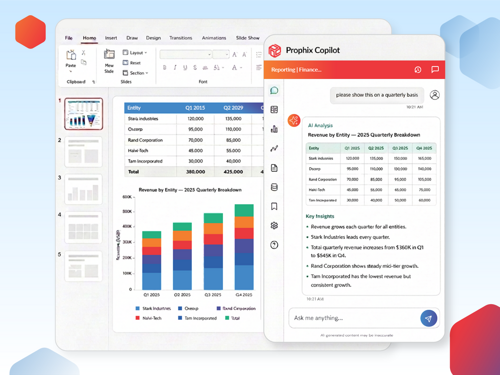
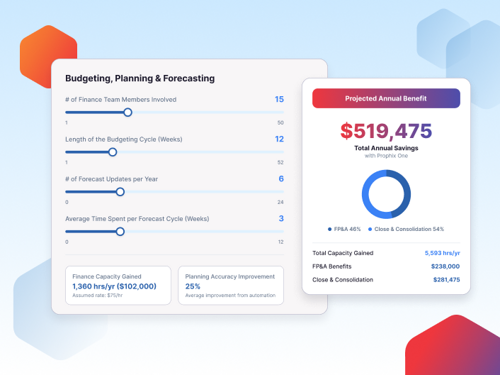
Many mid-market groups run consolidation in a spreadsheet that sits apart from the budget, the plan, and the close, so the same numbers get rebuilt at every stage and quarter-end becomes a search for support. Prophix One brings multi-entity consolidation into the same platform as the financial close, planning, budgeting, and reporting, so a consolidated result flows straight into group reporting instead of living in a separate tool. It automates currency translation, intercompany eliminations, ownership calculations, and consolidation adjustments, and gives finance a live view of where the consolidation stands across every entity. Prophix One Intelligence handles the high-volume preparation and surfaces the items that need review, with finance keeping oversight of every number. It is a glass-box approach, where you can trace how a consolidated figure was built.
Key features: Multi-entity and multi-currency consolidation, automated intercompany eliminations and ownership calculations, financial close, planning and budgeting, group and management reporting, and Prophix One Intelligence for automated preparation and the Prophix One Consolidation Agent. and anomaly detection.
Pros: Consolidation, close, and planning on one platform, so mid-market teams avoid stitching together separate tools; recognised in Gartner's close and consolidation market (below); strong reviews for support and onboarding.
Cons: As a full platform rather than a single-purpose consolidation engine, Prophix One rewards a proper implementation, and reviewers note teams that only need standalone statutory consolidation may get more than they need today.
Gartner Peer Insights: 4.4 / 5 from 87 reviews in the Financial Close and Consolidation market, where Prophix One is recognised among the highest rated by peers for North America.
G2: 4.4 / 5 from 219 reviews.
Independent recognition: In BARC's Financial Consolidation and Group Accounting Survey 26, Prophix earned 6 top-ranked results and 8 Leader results in the Midsize and Large Deployments peer group, with top rank for Project Success, Product Satisfaction, Currency Management, and Traceability and Auditability.
Pricing: Quote-based.
Customer outcome: Echelon Supply & Service replaced a consolidation run on a sprawling Excel workbook, where it combined trial balances, converted currencies, and eliminated intercompany balances by hand, with Prophix One.
"We use to have a million tab excel file that consolidated trial balances, converted the currencies, and eliminated intercompany balances. It was prone to errors and was never correct. Prophix helped make those steps easy and we close the books with confidence now. I highly recommend."
Thomas Scott, Director of Financial Planning & Analysis, Echelon Supply & Service
2. OneStream: Best for enterprises unifying CPM on one platform
OneStream unifies consolidation, close, planning, and reporting for large organisations on a single platform, built to handle thousands of entities, currencies, and ownership structures in one application. It is a common replacement for legacy tools like Oracle Hyperion.
Key features: Financial consolidation and close, multi-entity and multi-currency support, planning, reporting, and analytics, guided workflows, extensive ERP integrations.
Pros: Handles the most complex global consolidations; drill-through from a report to the underlying entity data; one platform across corporate performance management.
Cons: Reviewers note that implementation is a significant undertaking and that the platform can be more than a smaller team needs.
Gartner Peer Insights: 4.7 / 5 from 540 reviews in the Financial Close and Consolidation market.
G2: 4.6 / 5 from 160 reviews.
Pricing: Quote-based.
3. Oracle Cloud EPM: Best for organisations standardised on Oracle
Oracle Fusion Cloud EPM includes Financial Consolidation and Close, delivering out-of-the-box consolidations with pre-built statements and deep functionality for organisations invested in the Oracle ecosystem.
Key features: Financial consolidation and close, currency translation, intercompany eliminations, integration across the Oracle ecosystem, enterprise reporting.
Pros: Deep, mature functionality; strong fit for Oracle-standardised stacks; large partner and skills ecosystem.
Cons: Reviewers note the breadth brings complexity, and that value is highest inside the broader Oracle environment.
Gartner Peer Insights: 4.8 / 5 from 243 reviews in the Financial Close and Consolidation market.
G2: Oracle Cloud EPM has no single clean G2 listing; its reviews are split across products. Gartner is the reliable source here.
Pricing: Quote-based.
4. CCH Tagetik: Best for statutory and regulatory-heavy consolidation
CCH Tagetik, from Wolters Kluwer, delivers financial close and consolidation alongside statutory, regulatory, and ESG reporting on one platform, marketed to group and entity controllers with heavy compliance requirements.
Key features: Financial consolidation and close, statutory and regulatory reporting, disclosure management, planning, and ESG, with prebuilt ERP connectors.
Pros: Strong for organisations with heavy statutory, regulatory, and disclosure needs; combines balance and transactional data on one platform.
Cons: Reviewers note configuration complexity, and that the North American footprint is smaller than its European base.
Gartner Peer Insights: 4.6 / 5 from 205 reviews in the Financial Close and Consolidation market.
G2: 4.3 / 5 from 72 reviews.
Pricing: Quote-based.
5. Planful: Best for mid-market to enterprise close and consolidation
Planful supports consolidation alongside budgeting, forecasting, and reporting for mid-market and upper-mid-market groups, including conversion between IFRS and local GAAP, with a continuous-planning approach.
Pros: Covers consolidation and planning in one platform; structured processes that suit finance-led deployments.
Cons: Reviewers note an onboarding learning curve and some limits in report flexibility for complex needs.
Gartner Peer Insights: 4.5 / 5 from 96 reviews in the Financial Close and Consolidation market.
G2: 4.3 / 5 from 501 reviews.
Pricing: Quote-based.
6. Board: Best for consolidation with built-in analytics
Board offers group consolidation and reporting on a platform that combines planning, business intelligence, and analytics, so finance and operations can model and analyse on shared data.
Key features: Group consolidation and reporting, planning, business intelligence and analytics, prebuilt ERP integrators and a wide API set.
Pros: Flexible modelling combined with strong built-in analytics; useful when consolidation sits alongside operational reporting.
Cons: Reviewers note it requires configuration to build out, since much is assembled rather than prebuilt.
Gartner Peer Insights: 4.6 / 5 from 46 reviews in the Financial Close and Consolidation market.
G2: Board's G2 listing overlaps with board-meeting governance software, so its review count there is unreliable. Gartner is the reliable source for this platform.
Pricing: Quote-based.
7. Workday Adaptive Planning: Best for teams on the Workday ecosystem
Workday Adaptive Planning offers consolidation, planning, and reporting with live data from ERP, HR, and other systems, a natural fit for organisations already running Workday.
Key features: Consolidation, planning and forecasting, reporting and dashboards, integrations across the Workday ecosystem and beyond.
Pros: Approachable interface; strong fit for existing Workday customers; unifies planning and consolidation.
Cons: Reviewers note advanced consolidation and reporting can require additional configuration, and that cost reflects the enterprise positioning.
Gartner Peer Insights: 4.3 / 5 from 60 reviews in the Financial Close and Consolidation market.
G2: 4.3 / 5 from 344 reviews.
Pricing: Quote-based.
8. Anaplan: Best for connected planning with consolidation
Anaplan added financial close and consolidation through its 2024 acquisition of Fluence, pairing consolidation with the connected, cross-functional planning the platform is known for.
Key features: Multi-entity consolidation via Fluence, connected planning across functions, scenario analysis, low-code modelling.
Pros: Powerful, flexible modelling that scales; consolidation connected to enterprise-wide planning.
Cons: Reviewers note the consolidation capability is newer to the platform and that data integration can require skilled model builders.
Gartner Peer Insights: 4.3 / 5 from 28 reviews in the Financial Close and Consolidation market.
G2: 4.6 / 5 from 461 reviews.
Pricing: Quote-based.
9. Vena: Best for Excel and Microsoft 365-native consolidation
Vena delivers consolidation on a managed database while keeping a native Excel interface and integrating across Microsoft 365, so teams consolidate without leaving the spreadsheet environment they know.
Key features: Native Excel front end, centralised database, multi-entity consolidation, currency translation, Microsoft 365 integration, Power BI reporting.
Pros: Familiar Excel experience lowers the adoption barrier; tight fit with the Microsoft stack.
Cons: Reviewers note advanced consolidation rules carry a learning curve, and that very large models can affect performance.
Gartner Peer Insights: 4.5 / 5 from 26 reviews in the Financial Close and Consolidation market.
G2: 4.5 / 5 from 476 reviews.
Pricing: Quote-based.
10. LucaNet: Best for dedicated group and statutory consolidation
LucaNet is a purpose-built consolidation and reporting specialist with out-of-the-box support for IFRS, US GAAP, and local GAAP, aimed at finance teams that want audit-proof group statements without a broad platform.
Key features: Group consolidation, IFRS, US GAAP, and local GAAP support, statutory reporting, disclosure and ESG reporting, an interface built for finance users.
Pros: Dedicated consolidation depth with strong statutory coverage; approachable for finance teams; quick to audit-ready statements.
Cons: Reviewers note it is narrower than the full CPM platforms, so teams wanting planning and analysis alongside consolidation may need additional tools.
G2: 4.7 / 5 from 59 reviews. Listed in the Gartner Financial Close and Consolidation market but with too few reviews there to be reliable, so G2 is the source.
Pricing: Quote-based.
11. Workiva: Best for connected reporting and disclosure for public companies
Workiva is a connected reporting and compliance platform strong in SEC and ESG reporting. It aggregates data and controls the reporting process rather than serving as a core consolidation engine, so teams pair it with a consolidation tool.
Key features: Connected reporting across finance and compliance, data integration from multiple sources, audit trails, regulatory and disclosure filing.
Pros: Strong compliance, collaboration, and audit functionality for public companies; reliable traceability across the reporting process.
Cons: Reviewers note it is not built for end-to-end consolidation and relies on integrations or a separate tool for data aggregation, and that per-user cost can limit team-wide adoption.
G2: 4.5 / 5 from 1,855 reviews. Not rated in the Gartner Financial Close and Consolidation market as a consolidation engine.
Pricing: Quote-based.
12. Centage: Best for SMB budgeting and consolidation
Centage Planning Maestro is a cloud FP&A platform for small and mid-sized businesses, pairing budgeting and forecasting with consolidation and prebuilt GAAP and IFRS reporting templates.
Key features: Budgeting and forecasting, multi-entity consolidation, prebuilt financial reporting templates, integration with QuickBooks Online.
Pros: Approachable and quick to deploy for smaller finance teams; consolidation and planning without enterprise complexity.
Cons: Reviewers note it fits SMB needs rather than complex, many-entity global consolidation.
G2: 4.4 / 5 from 27 reviews. Not rated in the Gartner Financial Close and Consolidation market.
Pricing: Quote-based.
Others worth a look, depending on your stack: SAP S/4HANA Finance for group reporting for SAP-standardised shops, BlackLine and HighRadius for consolidation tied to close and reconciliation at scale, IBM Cognos Controller for established enterprise consolidation, and Datarails for Excel-based teams.
What is financial consolidation software?
Financial consolidation software combines the financial results of a parent company and its subsidiaries into one set of group financial statements. It pulls data from each entity's general ledger or ERP, converts foreign currencies into the reporting currency, eliminates intercompany transactions so nothing is double-counted, adjusts for partial ownership and minority interests, and produces consolidated statements that comply with GAAP or IFRS.
It helps to separate two related terms. Financial consolidation is the step that combines entities into group statements. The financial close is the broader process of finalising all financial records for a period, of which consolidation is one part. Many platforms cover both; for the close process specifically, see our guide to financial close software.
The features that separate a capable consolidation tool are the ones that automate the hard parts and hold up to an audit. Look for these when you evaluate:
Multi-entity roll-up: Combining any number of entities into group statements, including layered and partial ownership.
Currency translation: Automated conversion of foreign subsidiaries into the reporting currency at the right rates.
Intercompany eliminations: Automatic identification and removal of intercompany transactions to prevent double-counting.
Adjustments and minority interest: Handling top-side adjustments, reclassifications, and non-controlling interests.
ERP integration: Connections to SAP, Oracle, NetSuite, Microsoft Dynamics, and other source systems, ideally without heavy rework.
Audit trails and controls: A complete record of every adjustment and elimination, with preparer and reviewer sign-offs.
Group and statutory reporting: Consolidated statements plus statutory and management views across multiple GAAPs.
Benefits of financial consolidation software
Moving consolidation off spreadsheets turns a fragile month-end task into a controlled, mostly automated process. The benefits reported most consistently:
Faster close: Automated roll-up, eliminations, and currency translation cut days off the consolidated close.
Fewer errors: Consistent rules and validations catch discrepancies that manual spreadsheets miss.
Audit readiness: Complete audit trails and documentation make group audits less painful.
Real-time visibility: A live view of consolidated performance across entities, rather than waiting for a manual roll-up.
Scalability: New entities, currencies, and acquisitions absorb into the process without breaking it.
How financial consolidation works
Consolidation follows a consistent sequence, and understanding it clarifies what the software automates. The core steps: collect each entity's financial data and standardise accounting policies; translate foreign currencies into the reporting currency; eliminate intercompany transactions and balances; adjust for minority interests and make top-side adjustments; aggregate into group statements; and review and report.
Two distinctions shape which tool fits. Statutory consolidation produces the legally required group statements under GAAP or IFRS, while management consolidation reorganises the same data for internal decision-making, on a different chart of accounts; strong tools support both. And organisations vary in complexity: a group with three entities in one currency has very different needs from one with fifty entities across twenty jurisdictions and several ERPs, where multi-currency translation, multi-GAAP reporting, and deep ERP integration become decisive.
Use cases and industry applications
Financial consolidation software earns its place wherever one organisation has to report as a whole across many parts. The clearest fit is multi-entity organisations: any company with subsidiaries, divisions, or business units that each keep their own books and have to be combined into group balance sheets and income statements.
Multi-entity and international groups
Groups with international entities consolidate across currencies, chart-of-accounts differences, and local accounting standards, then roll their subsidiaries and business units up into one set of group statements. The software automates the currency translation and intercompany eliminations that make this slow by hand, and it strengthens financial governance by keeping every adjustment traceable and audit-ready.
Private equity and advisory use
Private equity firms use consolidation software to combine portfolio companies on different systems into a single view for management insight and investor reporting. Accounting and advisory firms put it to advisory use, running consolidations on behalf of clients and delivering audit-ready group statements without rebuilding spreadsheets for each engagement.
SAP and ERP-heavy environments
Organisations standardised on SAP have historically consolidated in SAP Business Planning and Consolidation (BPC). With BPC being phased out, many are moving to SAP S/4HANA group reporting or to a dedicated platform that integrates with SAP and other ERPs. The same pattern holds for Oracle, NetSuite, and Microsoft Dynamics shops that want consolidation to sit cleanly on top of the ERP.
Where AI agents fit
Newer platforms apply AI agents to the repetitive parts of consolidation: matching intercompany transactions, flagging anomalies in balance sheets and income statements before they reach the group statements, and drafting variance commentary for management insight. As elsewhere in finance, the software handles the high-volume work and routes exceptions to the team, and finance keeps oversight of the consolidated result.
By industry, the heaviest users are multi-entity organisations in manufacturing, financial services, healthcare, and professional services, along with any group growing through acquisition, where new subsidiaries and international entities have to fold into the close without weakening financial governance or audit-readiness.
Consolidation in spreadsheets vs software
Most groups start consolidating in Excel, and for a few entities in one currency, that can work. Spreadsheets are flexible and familiar. The problem is they do not connect to each entity's ERP, so every close means exporting, mapping, and combining data by hand, then redoing eliminations and currency translation each period.
That manual work introduces errors, breaks version control across a group, and slows as entities and currencies multiply, which is why consolidation is a common reason a close runs late. Dedicated software automates the roll-up, eliminations, and translation, keeps a full audit trail, and scales as the group grows. The honest test: if you have a handful of entities in one currency, a spreadsheet may hold for now; once you are managing multiple currencies, intercompany activity, or acquisitions, dedicated software earns its cost. For a fuller comparison, see financial consolidation software versus spreadsheets.
How to choose the best financial consolidation software
The best financial consolidation software is the one that matches your group's complexity, your ERP landscape, and your reporting obligations. Company size and entity count are the most reliable first filters.
Enterprises with many entities, currencies, and jurisdictions need deep multi-currency translation, multi-GAAP reporting, and enterprise governance. OneStream, Oracle Cloud EPM, CCH Tagetik, and Anaplan fit here.
Mid-market groups want consolidation that is finance-owned and connected to the close and planning, without heavy IT overhead. Prophix One, Planful, Vena, Board, and Workday Adaptive fit here.
Small businesses with a few entities need effective consolidation without complexity. Centage, LucaNet for statutory depth, and a well-built spreadsheet fit here.
Across all three, weigh the same factors: how cleanly the tool integrates with your ERPs, the depth of its intercompany elimination and currency translation, whether it supports both statutory and management reporting, audit-trail and controls strength, implementation effort and whether finance or IT owns it, and total cost. Most vendors are quote-based, so compare the full cost, not just the license. And a prerequisite that outranks features: consistent, well-mapped data across entities, since consolidation amplifies inconsistent source data rather than fixing it.
AI and the future of financial consolidation
AI is moving consolidation from a manual, spreadsheet-heavy cycle toward a process where the software takes the first pass and finance reviews the exceptions, but the useful question is what the AI does and how much control finance keeps.
The applications delivering value today cluster around a few jobs. Automated intercompany matching and elimination clears the routine transactions and flags mismatches for review. Anomaly detection surfaces unusual entries, duplicates, or out-of-pattern balances before they reach the group statements. Automated currency translation and multi-GAAP conversion reduce manual restatement. And AI-drafted variance commentary turns the write-up into a review step.
The pattern that fits a finance function is consistent: the software handles the high-volume, repeatable work and routes exceptions to the team, and finance keeps oversight of the consolidated result. Two conditions decide whether AI delivers. The data has to be clean and consistently mapped across entities, because consolidation built on inconsistent source data will not hold up. And the logic should be visible rather than a black box, so finance can stand behind a filed number. For Prophix's fuller view of where finance automation is heading, see Prophix's autonomous finance vision.
Key financial consolidation terms
The terms that come up most when you evaluate financial consolidation software.
Financial consolidation: Combining a parent and its subsidiaries into one set of group financial statements.
Intercompany elimination: Removing transactions between entities in the same group so they are not double-counted.
Currency translation: Converting foreign subsidiaries' figures into the group's reporting currency.
Minority (non-controlling) interest: The portion of a subsidiary not owned by the parent, accounted for separately in the group statements.
Top-side adjustment: A manual adjustment made at the group level during consolidation.
Statutory consolidation: The legally required group statements under GAAP or IFRS.
Management consolidation: The same data reorganised for internal decision-making.
Chart of accounts mapping: Aligning each entity's accounts to a common group structure.
Financial close: The broader period-end process of finalising records, of which consolidation is one part.
Frequently asked questions
What is the difference between financial consolidation and financial close?
Financial consolidation combines multiple entities into group statements. The financial close is the broader process of finalising all financial records for a period. Consolidation is one step within the close.
What is the difference between financial consolidation and accounting consolidation software?
Financial consolidation software combines entity data into consolidated statements, handling eliminations and currency translation. Accounting consolidation software integrates and reconciles accounting entries within financial systems. The terms overlap, but consolidation software is built for the group-reporting problem.
How does financial consolidation software handle multiple currencies?
It converts each foreign subsidiary's figures into the group's reporting currency using the appropriate exchange rates, automatically and consistently across periods, which removes a major source of manual error.
How does it integrate with my ERP?
Consolidation tools connect to SAP, Oracle, NetSuite, Microsoft Dynamics, and other ERPs through APIs or prebuilt connectors and pull each entity's data automatically. Integration depth is a key differentiator, especially for groups running several ERPs.
How much does financial consolidation software cost?
Most vendors price by quote based on entity count, users, and complexity, though some SMB tools publish tiers. Factor in implementation and ongoing administration, since enterprise platforms can carry significant setup cost.
Can I keep consolidating in spreadsheets?
For a few entities in one currency, a spreadsheet can work. As entities, currencies, and intercompany activity grow, manual roll-up and version control become the bottleneck, and dedicated software becomes worth the cost.
Which financial consolidation software is best for mid-market groups?
Mid-market groups commonly evaluate Prophix One, Planful, Vena, and Board. Prophix One is built for mid-market teams that want consolidation connected to the close and planning in one platform.
The bottom line
The best financial consolidation software is the one that matches your group's complexity and reporting obligations, from a three-entity business closing in one currency to a global group consolidating across dozens of jurisdictions. Each of the 12 tools here leads a real segment, and we show the ratings straight so you can weigh them against your own situation. Consolidation is where a multi-entity close is won or lost, and the right tool, connected to the way you plan and close, turns it from a fragile month-end task into a controlled process you can trust.
See a unified platform in action
If your group consolidates in one place and plans and closes the books in another, Prophix One brings consolidation, close, planning, and reporting together so a consolidated result flows straight into group reporting, with automation that keeps finance in control of every number. See how teams tie multi-entity consolidation to the close on one platform. Book a demo or explore our Financial Consolidation solution.