
Integrated Business Planning (xP&A) Software

When Finance and the Business Plan As One

Budgeting and forecasting were just the beginning. Prophix One connects financial and operational planning across every function so the whole business moves from one trusted plan.

THE CHALLENGE

Finance Has a Plan but the Rest of the Business Has a Different One

Prophix Visual Analytics Colour

Financial and Operational Plans Live in Separate Worlds

Finance builds the budget. Sales builds the pipeline forecast. HR builds the headcount plan. Ops builds the capacity model. None of them talk to each other. When sales blows past quota, finance is the last to know what it means for margin. When ops hits a capacity constraint, the financial plan keeps assuming growth that can't be delivered. Planning happens in silos. The business pays for it.

Prophix Error Colour

Leadership Can't Get a Single View of Performance and Plan

The CFO has a number. The CRO has a number. The COO has a number. They don't reconcile. Leadership spends the first 20 minutes of every review debating which figure is right instead of what to do about it. A single version of the plan every function owns and every leader trusts is the most valuable thing finance can produce.

Prophix Decision Making Colour

Operational Changes Don't Flow Through to the Financial Model

A sales leader adjusts the territory plan. An ops manager revises capacity. HR approves 20 new hires. None of it reaches the financial model until someone manually reworks the numbers. Strategic decisions get made without a current financial view, and finance finds out at month-end when the variance is already baked in.

KEY CAPABILITIES

Prophix One Makes the Whole Business Plan Smarter

Four capabilities that connect financial and operational planning into a single, always-current view of where the business is going and what it will take to get there.

Connected Planning

Connected Planning

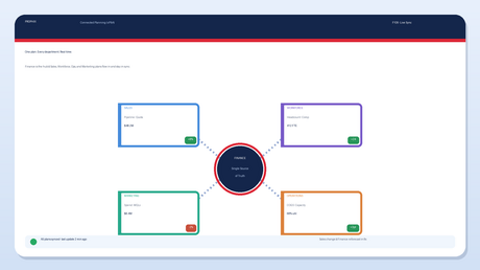
Prophix One connects financial and operational planning in a single environment. Finance, sales, HR, and operations all plan against the same data, the same drivers, the same version of the truth. When assumptions change in one function, the impact flows through every connected plan automatically.

Sales Planning

Revenue & Sales Planning

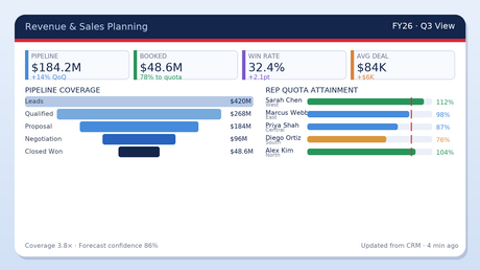
Connect sales pipeline data directly to the financial model. Revenue forecasts update automatically as pipeline moves. Finance and sales work from the same number, no quarterly debate between CRM forecasts and finance-built revenue models.

Workforce Planning

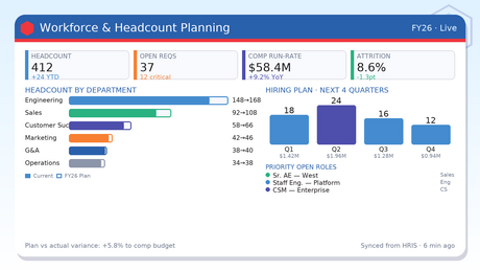
Workforce & Headcount Planning

Connect HR headcount plans to the financial model so every open role, new hire, and departure carries its full cost impact. Finance and HR plan together instead of in sequence. Leadership sees the financial impact of workforce decisions before they're approved, not after they show up in variance.

Supply Chain Operational Planning

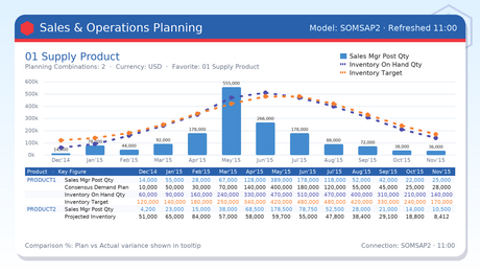
Supply Chain & Operational Planning

Connect operational capacity, volume, and cost drivers to the financial model so changes in production, logistics, or supply chain feed through to margin and cash projections in real time. Finance stops learning about operational constraints at month-end and starts incorporating them as they happen. Operational leaders see the financial impact of their decisions before they make them.

When Every Function Plans Together, Finance Leads the Business

Prophix One connects financial and operational planning into a single, governed platform. The whole organisation moves from one trusted plan. Finance makes it possible.

Frequently Asked Questions

What is Integrated Business Planning (IBP) and How is it Different From FP&A?

Traditional FP&A focuses on the financial plan, budget, forecast, and variance analysis, owned and managed by finance. Integrated business planning (IBP) extends that process across every function, connecting financial plans to operational plans in sales, HR, supply chain, and operations. The goal is a single, coordinated plan where financial assumptions and operational realities are always aligned. IBP is what FP&A evolves into when the business needs finance to do more than report the numbers: it needs finance to connect and coordinate them across the whole organisation.

Prophix One uses a shared driver framework that connects financial outputs to the operational inputs that determine them. Headcount changes in HR flow through to salary, benefits, and overhead costs in the financial model. Pipeline movements in sales flow through to revenue projections. Capacity changes in operations flow through to COGS and margin. Each function plans in its own domain, but all plans share the same underlying data and driver structure, so a change in one function updates the financial implications across all others automatically, without manual reconciliation.

Budgeting and forecasting on Prophix One give finance a better internal process, faster cycles, driver-based models, collaborative inputs. IBP extends that by pulling operational planning into the same platform and the same model. The difference is scope: budgeting and forecasting make finance more efficient; IBP makes the whole business more aligned. For organisations where the biggest planning problem isn't the quality of the finance model but the gap between finance and the rest of the business, IBP is the natural next step.

Workforce planning in Prophix One connects your headcount plan directly to your financial model. HR and finance planning teams manage open roles, approved hires, departures, and compensation changes in a shared environment. Every headcount movement carries its full cost impact, salary, benefits, equipment, real estate, and overhead allocations, calculated automatically based on your defined cost structure. Finance sees the total people cost in real time as the headcount plan evolves. Leadership sees the financial implications of hiring decisions before they're approved, not after they show up in the income statement.

Prophix One connects to CRM and sales pipeline data so that revenue projections in the financial model update as pipeline moves. Finance and sales work from the same underlying data rather than maintaining parallel forecasts that diverge every quarter. Sales leaders see the financial context for their pipeline targets. Finance sees real-time revenue implications of pipeline changes rather than waiting for a weekly sync or a month-end close to reconcile the gap. The result is one revenue number both functions own, with fewer surprises for either side at quarter-end.

IBP has traditionally been associated with large enterprises, complex supply chains, global operations, dedicated planning teams. But mid-market companies face the same cross-functional alignment problem at smaller scale, often with fewer resources to absorb the cost of misalignment. Prophix One makes IBP accessible to mid-market finance teams by starting where they already are, connected budgeting and forecasting, and extending incrementally into operational planning domains as the organisation is ready. You don't have to implement everything at once. Most Prophix One customers start with financial planning and add operational connections over time as the value becomes clear.

Prophix One Intelligence monitors the integrated plan across all connected functions, surfacing anomalies and misalignments that would be invisible in a siloed planning environment. It flags when operational trends are diverging from financial assumptions: when pipeline growth is outpacing capacity, when hiring pace is ahead of revenue, when cost trends suggest a margin miss before the period closes. Finance moves from reactive to proactive. Instead of explaining variances after the fact, the team intervenes before they materialise, which is the entire promise of integrated business planning.

Most organisations implement Prophix One IBP incrementally rather than all at once. Financial planning typically goes live first, within weeks of implementation, followed by operational planning domains as the team is ready. The pace depends on your existing data infrastructure, the number of functions being connected, and the complexity of your driver relationships. Prophix's implementation team works alongside finance to sequence the rollout around your planning calendar so you're not building while a major planning cycle is in flight. For most mid-market organisations, full cross-functional connectivity is achieved within a single planning year.

Yes. Prophix One connects to the systems mid-market organisations use across finance, sales, and HR, including ERP and GL systems like Microsoft Dynamics, Sage Intacct, NetSuite, and SAP; CRM platforms for sales pipeline data; and HRIS systems for headcount and compensation data. These integrations are what make IBP practical rather than theoretical: the plan stays current because the data flows automatically, not because someone remembers to update a spreadsheet. Your Prophix implementation team maps the integration architecture as part of the initial engagement.