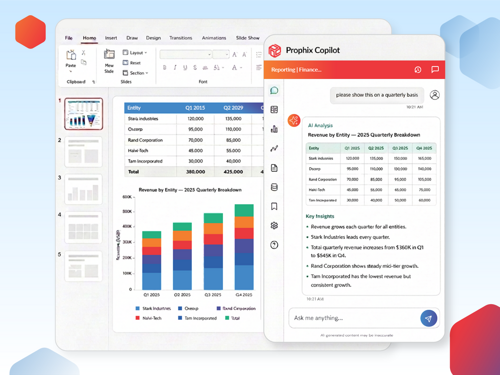
Every finance leader has watched the AI demo: it reads your workbook, explains your formulas in plain English, and answers questions about your data in a conversational tone. It’s approachable – and it’s impressive. If your team is living inside of Excel workbooks on the day to day, why not add AI right into the interface they already know?
AI for Excel, like Claude, integrates intelligence into your existing spreadsheet workflows. For teams that spend all day in spreadsheets, it’s intriguing: make analysts faster inside the environment they’re already using
But faster at what, exactly? And what value is "fast" if it's just a quick fix.
This is a question that finance leaders need to ask before they mistake a productivity upgrade for a transformation strategy.
Every finance leader has watched the AI demo: it reads your workbook, explains your formulas in plain English, and answers questions about your data in a conversational tone. It’s approachable – and it’s impressive. If your team is living inside of Excel workbooks on the day to day, why not add AI right into the interface they already know?
AI for Excel, like Claude, integrates intelligence into your existing spreadsheet workflows. For teams that spend all day in spreadsheets, it’s intriguing: make analysts faster inside the environment they’re already using
But faster at what, exactly? And what value is "fast" if it's just a quick fix.
This is a question that finance leaders need to ask before they mistake a productivity upgrade for a transformation strategy.
AI in Excel got smarter, but the problem didn’t
AI tools bolted onto Excel make you faster within your spreadsheet. But there are limitations of spreadsheet-based finance. They have no awareness of the financial model your organisation actually runs on. They can't tell you whether the number in cell D47 reflects last night’s ERP sync or a manual override from three weeks ago. There’s no governance layer, no audit trail, no consolidation logic, no workflow – and no visibility into what others in your organisation are doing with the same data.
For a single analyst building a one-off model, those gaps don’t matter. For an entire finance function responsible for the full finance lifecycle – the close, multi-entity consolidation, budgeting across cost centres, and reporting to the board – those gaps are the whole job.
There’s also a subtler risk that rarely comes up in demos: AI in spreadsheets is inherently probabilistic. It predicts the most likely formula and the most likely output. But finance isn’t a “most likely” discipline. Statutory reporting, multi-currency eliminations, and intercompany consolidations require deterministic logic. In finance, 99% accuracy is 0% trust.
AI in Excel got smarter, but the problem didn’t
AI tools bolted onto Excel make you faster within your spreadsheet. But there are limitations of spreadsheet-based finance. They have no awareness of the financial model your organisation actually runs on. They can't tell you whether the number in cell D47 reflects last night’s ERP sync or a manual override from three weeks ago. There’s no governance layer, no audit trail, no consolidation logic, no workflow – and no visibility into what others in your organisation are doing with the same data.
For a single analyst building a one-off model, those gaps don’t matter. For an entire finance function responsible for the full finance lifecycle – the close, multi-entity consolidation, budgeting across cost centres, and reporting to the board – those gaps are the whole job.
There’s also a subtler risk that rarely comes up in demos: AI in spreadsheets is inherently probabilistic. It predicts the most likely formula and the most likely output. But finance isn’t a “most likely” discipline. Statutory reporting, multi-currency eliminations, and intercompany consolidations require deterministic logic. In finance, 99% accuracy is 0% trust.
Can AI in Excel replace a CPM platform?
The promise of AI in Excel in appealing – and not just because it’s familiar. It’s fast: finance doesn’t need to wait on implementation, analysts can get answers quickly, and leadership can analyse data on their own terms. For a function that is historically slowed by implementation complexity and vendor dependency, that kind of autonomy feels like real progress.
And self-serve is progress. Just not in a spreadsheet.
Self-serve only works well when everyone is accessing the same source. When AI makes it easier for each person to work faster inside their own spreadsheet, you don’t get autonomy and scale... you get faster fragmentation.
This is spreadsheet sprawl 2.0. AI lowers the barrier to creating models, which sounds like a good thing until you realise it accelerates the production of fragmented, un-auditable finance models across the organisation. Without a governed foundation, AI doesn’t solve the chaos – it helps you produce it faster.
The answer isn’t to abandon self-serve. It’s to build it on a foundation where self-serve is governed – clean, accessible data, a single version of the truth, with the right people seeing the right numbers. That’s what a CPM platform provides. Real autonomy without the fragmentation risk.
Can AI in Excel replace a CPM platform?
The promise of AI in Excel in appealing – and not just because it’s familiar. It’s fast: finance doesn’t need to wait on implementation, analysts can get answers quickly, and leadership can analyse data on their own terms. For a function that is historically slowed by implementation complexity and vendor dependency, that kind of autonomy feels like real progress.
And self-serve is progress. Just not in a spreadsheet.
Self-serve only works well when everyone is accessing the same source. When AI makes it easier for each person to work faster inside their own spreadsheet, you don’t get autonomy and scale... you get faster fragmentation.
This is spreadsheet sprawl 2.0. AI lowers the barrier to creating models, which sounds like a good thing until you realise it accelerates the production of fragmented, un-auditable finance models across the organisation. Without a governed foundation, AI doesn’t solve the chaos – it helps you produce it faster.
The answer isn’t to abandon self-serve. It’s to build it on a foundation where self-serve is governed – clean, accessible data, a single version of the truth, with the right people seeing the right numbers. That’s what a CPM platform provides. Real autonomy without the fragmentation risk.
System of record vs. System of action
There's a useful distinction that gets lost in the Excel add-ins vs. FP&A software debate: the difference between a system of record and a system of action.
A system of record stores what happened. A system of action responds to it — orchestrating the next step across the organisation, closing the loop between insight and execution.
Spreadsheets, even AI-augmented, are a system of record at best. It captures data, surfaces analysis, and produces outputs. But it doesn't trigger a collections workflow when cash flow dips. It doesn't feed close insights back into the planning model for next month. It doesn't simulate mitigation strategies when a macro risk appears and produce a board-ready narrative tied to executed actions.
A CPM platform does. Decision, execution, and communication stay synchronised — and auditable.
There's also the question of institutional memory. Spreadsheets forget the context of a decision the moment the file is saved locally. Dedicated platforms capture the "why" behind the numbers – creating a persistent audit trail that protects the organisation when key analysts leave and gives auditors something to work with. That institutional memory is enterprise value. A spreadsheet, however intelligent, doesn't accumulate it.
System of record vs. System of action
There's a useful distinction that gets lost in the Excel add-ins vs. FP&A software debate: the difference between a system of record and a system of action.
A system of record stores what happened. A system of action responds to it — orchestrating the next step across the organisation, closing the loop between insight and execution.
Spreadsheets, even AI-augmented, are a system of record at best. It captures data, surfaces analysis, and produces outputs. But it doesn't trigger a collections workflow when cash flow dips. It doesn't feed close insights back into the planning model for next month. It doesn't simulate mitigation strategies when a macro risk appears and produce a board-ready narrative tied to executed actions.
A CPM platform does. Decision, execution, and communication stay synchronised — and auditable.
There's also the question of institutional memory. Spreadsheets forget the context of a decision the moment the file is saved locally. Dedicated platforms capture the "why" behind the numbers – creating a persistent audit trail that protects the organisation when key analysts leave and gives auditors something to work with. That institutional memory is enterprise value. A spreadsheet, however intelligent, doesn't accumulate it.
What's the difference between Excel with AI and a CPM platform?
The organisations that succeed aren’t giving every analyst a better Excel experience with AI. They are moving their governed financial truth off the spreadsheets – and adding an intelligence layer on top of that, like an AI-powered finance platform.
That order of operations matters. AI in Excel doesn’t fix a bad foundation – it amplifies what already exists. Clean, governed data makes AI genuinely powerful. Messy, fragmented spreadsheets make AI a faster way to work with outdated information.
What's the difference between Excel with AI and a CPM platform?
The organisations that succeed aren’t giving every analyst a better Excel experience with AI. They are moving their governed financial truth off the spreadsheets – and adding an intelligence layer on top of that, like an AI-powered finance platform.
That order of operations matters. AI in Excel doesn’t fix a bad foundation – it amplifies what already exists. Clean, governed data makes AI genuinely powerful. Messy, fragmented spreadsheets make AI a faster way to work with outdated information.
Individual level task productivity
End-to-end process execution across finance
Individual level task productivity
End-to-end process execution across finance
Fragmented; different versions across desktops and models; file-based; limited data volume
Centralised; one database; globally synchronised; large data volumes
Fragmented; different versions across desktops and models; file-based; limited data volume
Centralised; one database; globally synchronised; large data volumes
Probabilistic AI assistance; dependence on prompts
Deterministic financial logic
Probabilistic AI assistance; dependence on prompts
Deterministic financial logic
Limited or reliant on separate tools
Natively integrated and enforced
Limited or reliant on separate tools
Natively integrated and enforced
Opaque data integrity controls; manual
Audit trail with user stamps and source system tracking; engine-led procedural logic
Opaque data integrity controls; manual
Audit trail with user stamps and source system tracking; engine-led procedural logic
Brittle due to file-based architecture
Scalable across large user communities
Brittle due to file-based architecture
Scalable across large user communities
File-level passwords and folder permissions
Role-based or granular access control
File-level passwords and folder permissions
Role-based or granular access control
Built-in, immutable audit trails
Built-in, immutable audit trails
A CPM platform provides what Excel – no matter how AI-augmented – structurally cannot: a single version of the truth, with the workflow, consolidation logic, audit trail, and security model already built in. When AI operates on top of that foundation, it’s answering real questions with real data. When it operates on top of a spreadsheet, it’s doing its best with whatever you’ve given it.
The question for finance leaders isn’t whether AI in Excel is impressive. It's whether impressive is sufficient. For a finance function that the business depends on, it isn’t.
That’s the case for building the foundation first – and it’s what Prophix One is designed to be.
A CPM platform provides what Excel – no matter how AI-augmented – structurally cannot: a single version of the truth, with the workflow, consolidation logic, audit trail, and security model already built in. When AI operates on top of that foundation, it’s answering real questions with real data. When it operates on top of a spreadsheet, it’s doing its best with whatever you’ve given it.
The question for finance leaders isn’t whether AI in Excel is impressive. It's whether impressive is sufficient. For a finance function that the business depends on, it isn’t.
That’s the case for building the foundation first – and it’s what Prophix One is designed to be.
Ready to map out your AI journey with a CPM platform?
Ready to map out your AI journey with a CPM platform?
Frequently asked questions about AI in Excel and CPM platforms
Is AI in Excel good for finance teams?
AI in Excel is useful for individual productivity, like ad hoc analysis or exploratory modelling. Where AI in Excel falls short is at the function level – there's no audit trail, no governed data model, and no consolidation logic. It accelerates individual work; it doesn’t replace the infrastructure finance teams depend on.
What’s the difference between Excel with AI and a CPM platform?
Excel with AI improves how fast you can work with your spreadsheets. A CPM platform governs the data underneath it, providing a single version of the truth, deterministic financial logic, and workflow orchestration across the entire finance function. AI in Excel is a tool; a CPM platform is an operating model.
Can AI replace FP&A software?
AI can’t replace FP&A software at an enterprise scale. Generative AI is probabilistic – it predicts likely outputs. Financial reporting requires deterministic logic. AI and FP&A software work best together: AI on top of a governed platform, not a substitute for one.
Frequently asked questions about AI in Excel and CPM platforms
Is AI in Excel good for finance teams?
AI in Excel is useful for individual productivity, like ad hoc analysis or exploratory modelling. Where AI in Excel falls short is at the function level – there's no audit trail, no governed data model, and no consolidation logic. It accelerates individual work; it doesn’t replace the infrastructure finance teams depend on.
What’s the difference between Excel with AI and a CPM platform?
Excel with AI improves how fast you can work with your spreadsheets. A CPM platform governs the data underneath it, providing a single version of the truth, deterministic financial logic, and workflow orchestration across the entire finance function. AI in Excel is a tool; a CPM platform is an operating model.
Can AI replace FP&A software?
AI can’t replace FP&A software at an enterprise scale. Generative AI is probabilistic – it predicts likely outputs. Financial reporting requires deterministic logic. AI and FP&A software work best together: AI on top of a governed platform, not a substitute for one.